

ORIF - Compression plating
1. Principles
Simple transverse fractures can also be treated with compression plating. Although this provides absolute stability, it requires direct reduction methods which carry an increased risk of wound-healing complications.
Compression plating
The objective of compression plating is to produce absolute fracture stability by pre-loading the fracture to eliminate interfragmentary motion.
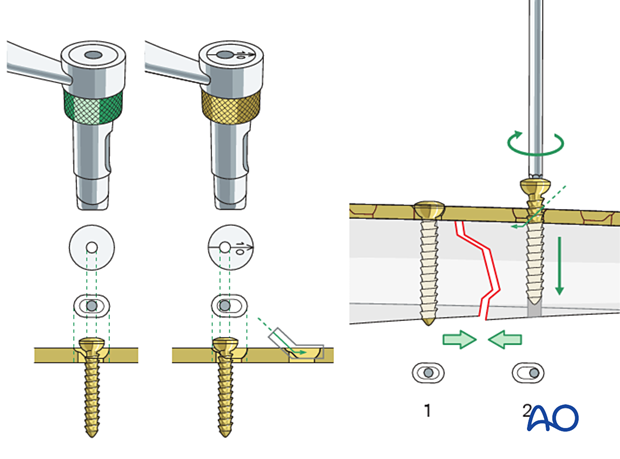
Compression plating is useful in two-part transverse fracture patterns, where the bone fragments can be compressed. The fracture orientation prevents use of a lag screw. Compression of the fracture is achieved by eccentric screw placement through one or more of the dynamic compression plate holes. The sides of these holes are inclined so that the screw head can translate the plate to produce compression.
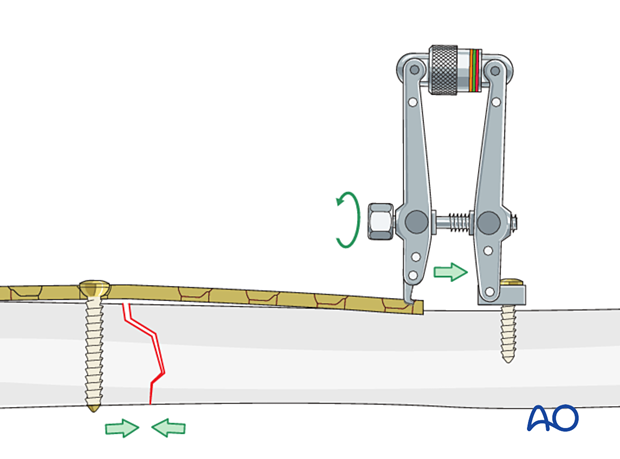
Compression can also be applied with an articulated tension device.
2. Preoperative planning
Planning the plate position
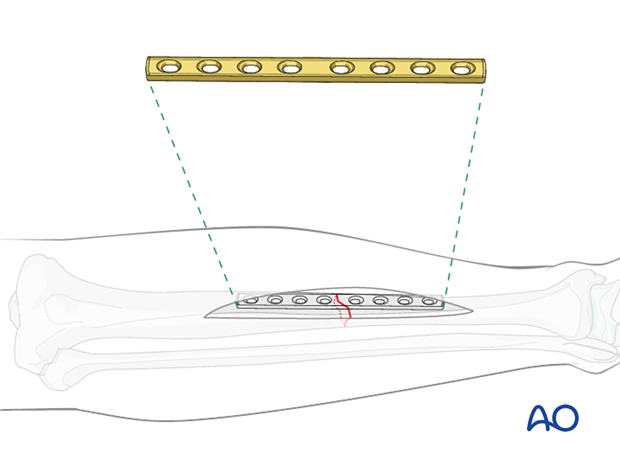
The center of the plate should be over the fracture line. Choose an 8-hole narrow 4.5 mm dynamic compression plate (DCP) that allows 3–4 screws in each fragment.
Overbending the plate
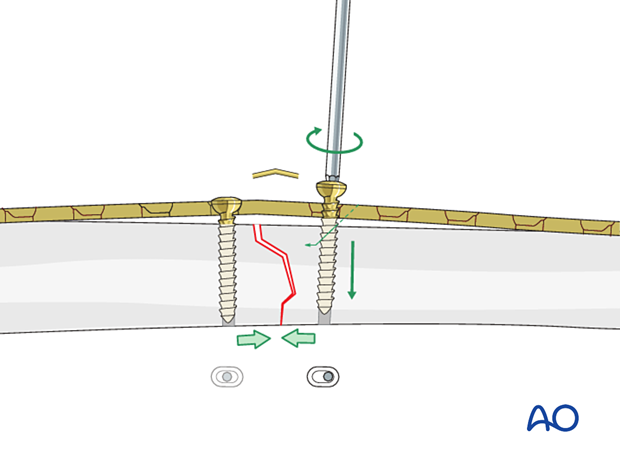
To compress the opposite cortex, the plate should be slightly overbent (more convex) at the fracture, so there is a small gap between plate and bone. This causes the cortex opposite the plate to be compressed first, as the eccentrically placed plate screws are tightened. With further tightening, the near cortex of the fracture subsequently becomes compressed. This short, convex (away from the bone) bend can be made with handheld bending pliers or a pair of bending irons.
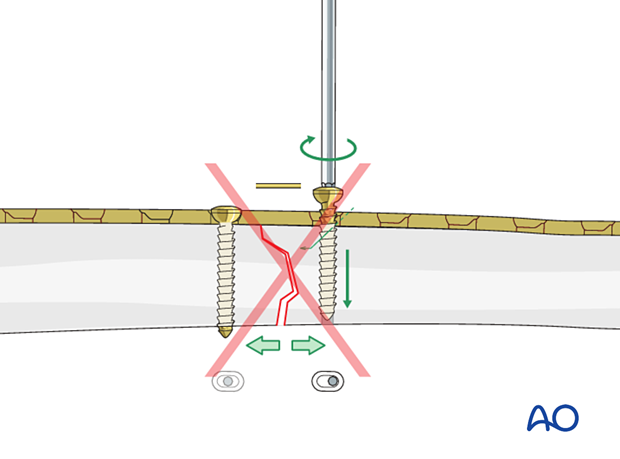
If axial compression is applied in a transverse fracture with a plate that is not overbent, compression first occurs at the cortex under the plate. This causes a gap in the fracture opposite the plate, resulting in instability. Such a gap must be avoided as it will lead to delayed or nonunion.
3. Patient preparation and approaches
Patient preparation
Depending on the approach, the patient may be placed in the following positions:
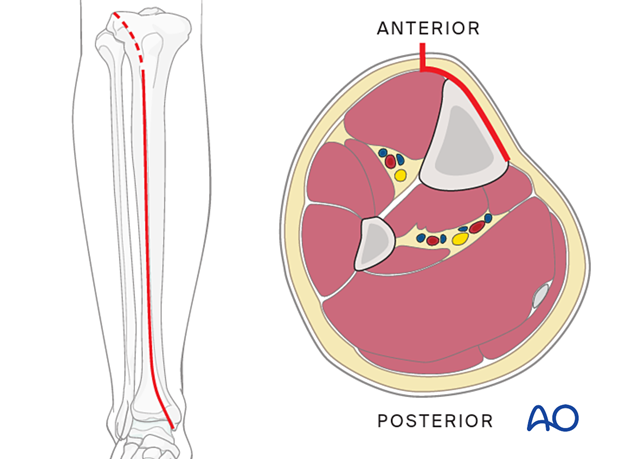
Anteromedial approach
The anteromedial approach is used most commonly for fractures of the distal third of the tibial shaft. It can be used to expose the entire anteromedial surface.
It is also useful for debridement and irrigation of open fractures when an incision on the injured subcutaneous surface is to be avoided.
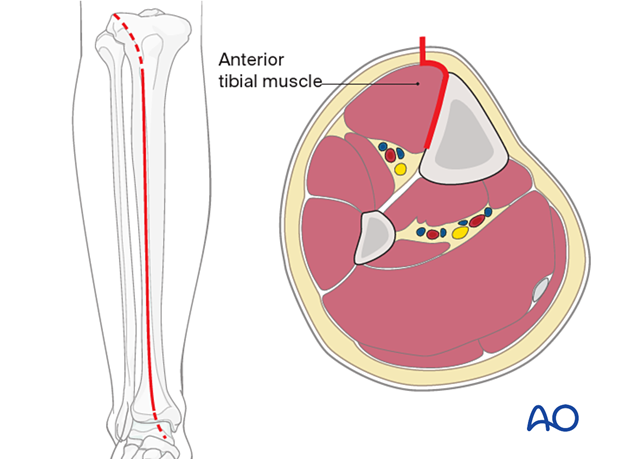
Anterolateral approach
The anterolateral approach is used uncommonly, but may be necessary when the medial soft tissues are compromised.
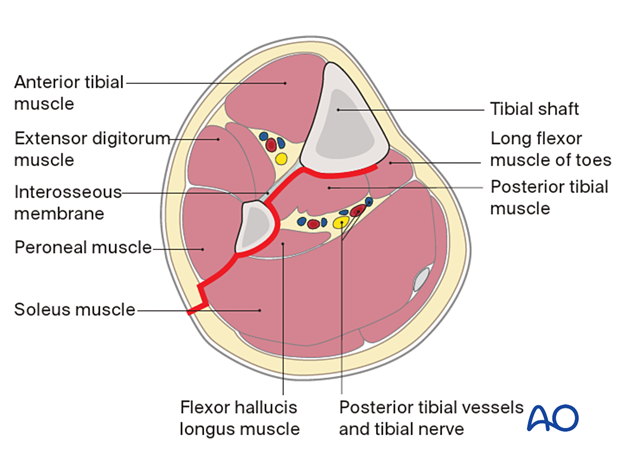
Posterolateral approach
The posterolateral approach can be used for open plate fixation of the tibia on its posterior surface. This may be necessary when the anterior soft tissues are compromised. Careful preoperative planning and attention to surgical technique is imperative for this rarely-used surgical approach.
This approach is often also utilized for the treatment of non-unions with posterolateral bone grafting. It allows access to both the tibia and fibula.
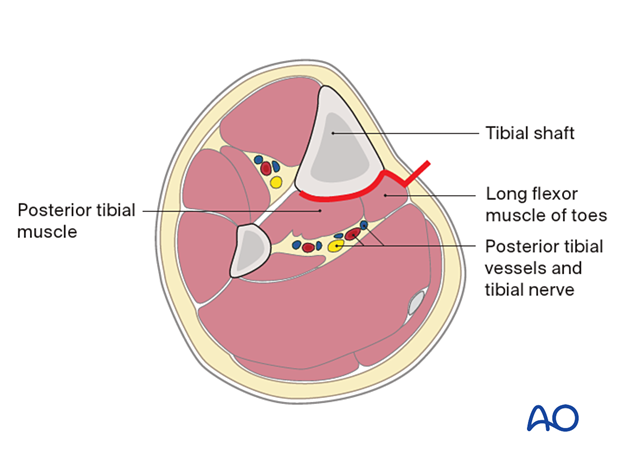
Posteromedial approach
The posteromedial approach can be used for open plate fixation of the tibia on its posterior surface. Typically, this approach would be chosen, when direct exposure for open reduction and internal fixation (ORIF) is desired, but only the posteromedial soft tissues are safe to incise.
Note that this incision is also the one that might be used for a medial fasciotomy for compartment decompression.
4. Open reduction
Introduction
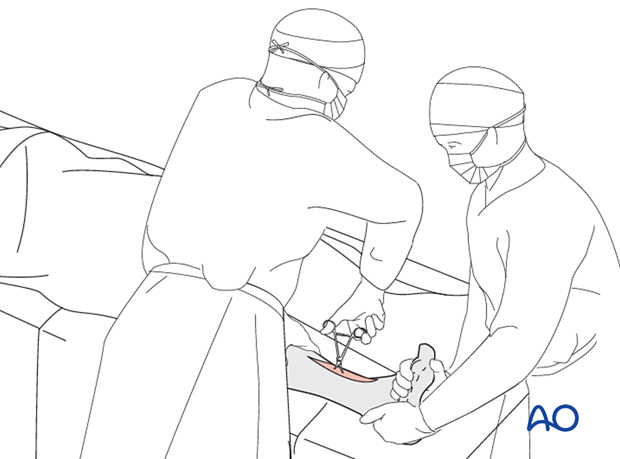
As anatomical reduction is necessary, open, or direct, reduction is needed.
Mobilize just enough of the periosteum around the fracture edges to assess the quality of the reduction. Take care to protect the periosteum wherever possible.
It is best to use pointed reduction forceps because they do less damage to the periosteum and soft tissues.
Reduction of the fracture
As the fracture is reduced use the pointed reduction forceps to rotate the fragments into anatomic position.
Simple transverse fractures are often stable enough for the plate to be applied without provisional fracture fixation. Make sure that the reduction remains satisfactory before drilling and inserting screws for the plate.

5. Fixation
Insert the first screw
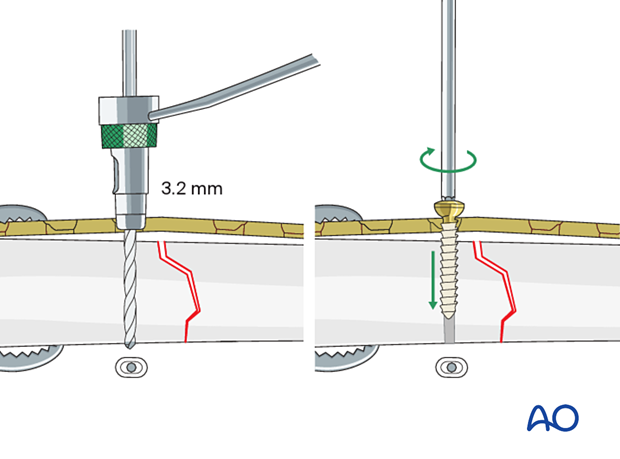
Drill with a 3.2 mm drill bit and drill guide in neutral mode through the plate hole as close as possible to the fracture line. Measure for screw length and insert the first screw, but do not fully tighten it yet.
Axial compression with eccentric screw
With the plate properly positioned, drill eccentrically for the second screw in the opposite fragment, using the eccentric drill guide (gold ring). Measure and insert the eccentric screw and alternately tighten both screws. Confirm adequate compression and reduction.
Insert second eccentric screw
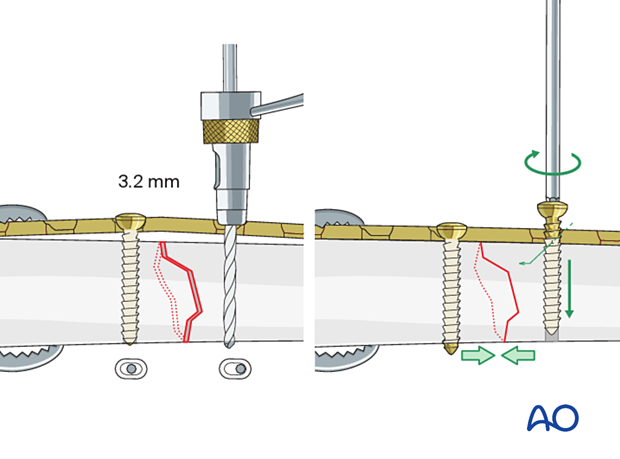
To increase axial compression, a second screw can be placed eccentrically next to the first (neutral) screw.
When the second eccentric screw is tightened, the first (neutral) screw needs to be loosened to allow the plate to slide on the bone.
Insertion of remaining screws
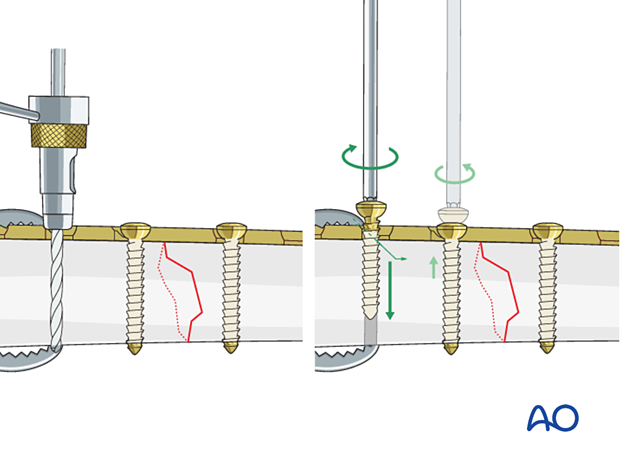
All other screws are inserted in neutral mode (drill sleeve with green ring). They will not add to compression. Insert the screws alternating between the proximal and distal fragments. Start with the screws closest to the fracture plane and work outwards.
At least four screws should be used on each fragment.

6. Articulated tension device
Adequate compression of the fracture can also be achieved with the help of an articulated tension device (ATD). The ATD can also be reversed to push on the plate and regain length, if needed.
7. Aftercare
Perioperative antibiotics may be discontinued before 24 hours.
Attention is given to:
- Pain control
- Mobilization without early weight bearing
- Leg elevation in the presence of swelling
- Thromboembolic prophylaxis
- Early recognition of complications
Soft-tissue protection
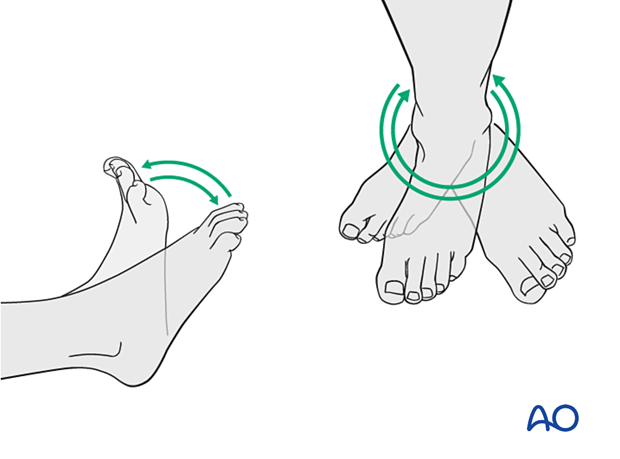
A brief period of splintage may be beneficial for protection of the soft tissues but should last no longer than 1–2 weeks. Thereafter, mobilization of the ankle and subtalar joints should be encouraged.
Mobilization
Active, active assisted, and passive motion of all joints (hip, knee, ankle, toes) may begin as soon as the patient is comfortable. Attempt to preserve passive dorsiflexion range of motion.
Weight bearing
For fractures treated with plating techniques, limited weight bearing (15 kg maximum), with crutches, may begin as tolerated, but full weight bearing should be avoided until fracture healing is more advanced (8–12 weeks).
For fractures treated with intramedullary nailing, weight bearing as tolerated, with crutches, may begin immediately.
Follow-up
Follow-up is recommended after 2, 6, and 12 weeks and every 6–12 weeks thereafter until radiographic healing and function are established. Weight bearing can be progressed after 6–8 weeks when x-rays have indicated that the fracture has shown signs of progressive healing.
Implant removal
Implant removal may be necessary in cases of soft-tissue irritation caused by the implants. The best time for implant removal is after complete bone remodeling, usually at least 12 months after surgery. This is to reduce the risk of refracture.


