

Key differences between pediatric and adult patients
1. Key similarities
Besides differences, there are key similarities between trauma care of pediatric and adult patients:
- Team based resuscitation
- Treatment during evaluation
- Primary survey, secondary survey, imaging, disposition
- Thresholds for trauma activation
2. Key differences
- Hypovolemia may be masked.
- Hypotension is a late sign.
- Physiological response and multiple organ failure patterns differ.
- Children lose heat rapidly.
- Elastic tissues may hide severe internal injury.
- Higher incidence of TBI
- SCIWORA may occur.
- Presence of growth plates
3. Pediatric resuscitation
See the chapter on Emergency assessment and management for pediatric considerations on:
- Airway
- Breathing
- Circulation
- Cervical spine protection
4. Physiological response
The physiological responses to major trauma in the child differ from those in the adult.
In adult trauma patients, injury to organ systems leads to a cascade of inflammatory activation, resulting in endothelial permeability, interstitial oedema, intravascular occlusion, microvascular ischemia and eventual multiple organ failure. The rate and overall pattern of multiple organ failure is different in children compared with adults, because of differences in physiology.
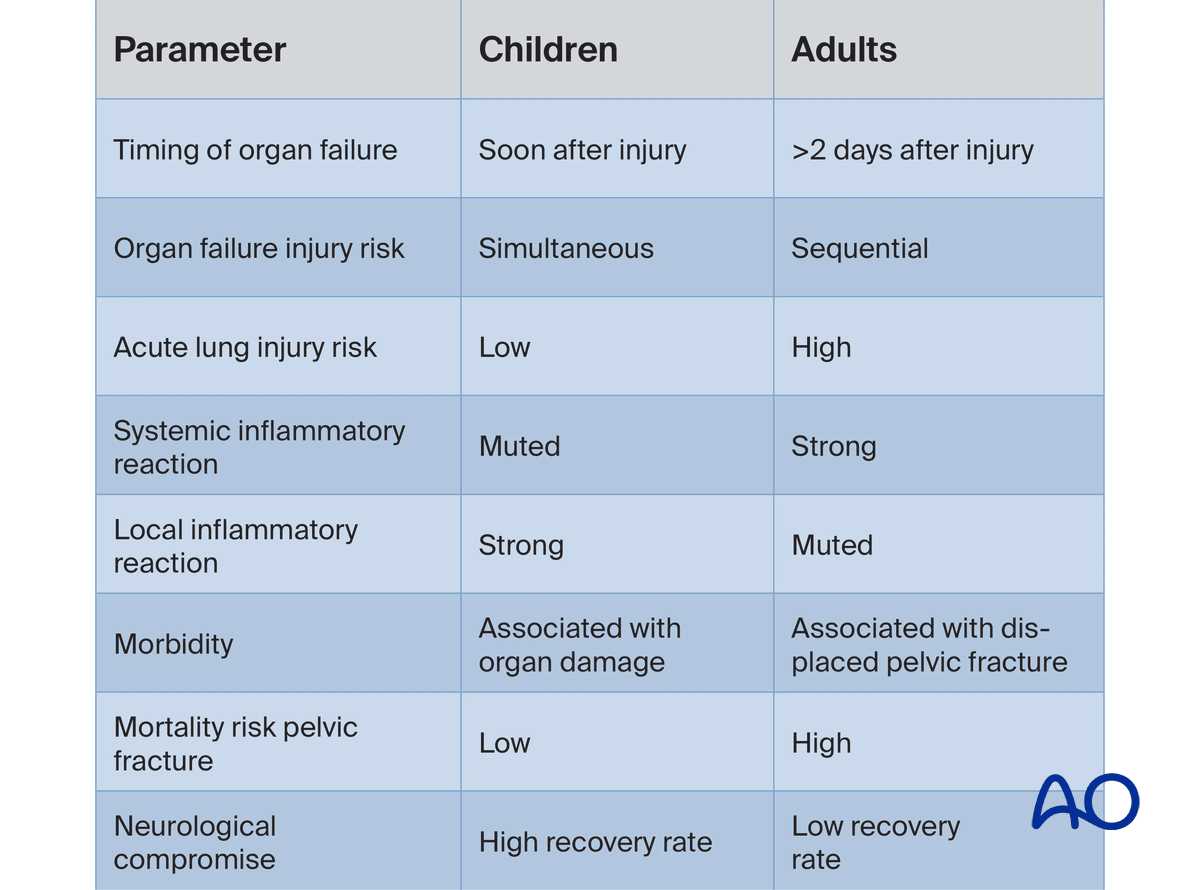
Timing of multiple organ failure in pediatric trauma patients differs from that in adult trauma patients. In children, multiple organ failure often occurs early after admission during resuscitation and affects all organs almost simultaneously, whereas organ failure in adults begins 48 hours after injury and occurs sequentially, starting with the lungs.
This table shows pediatric versus adult response to multiple injury.
5. Hypothermia in pediatric patients
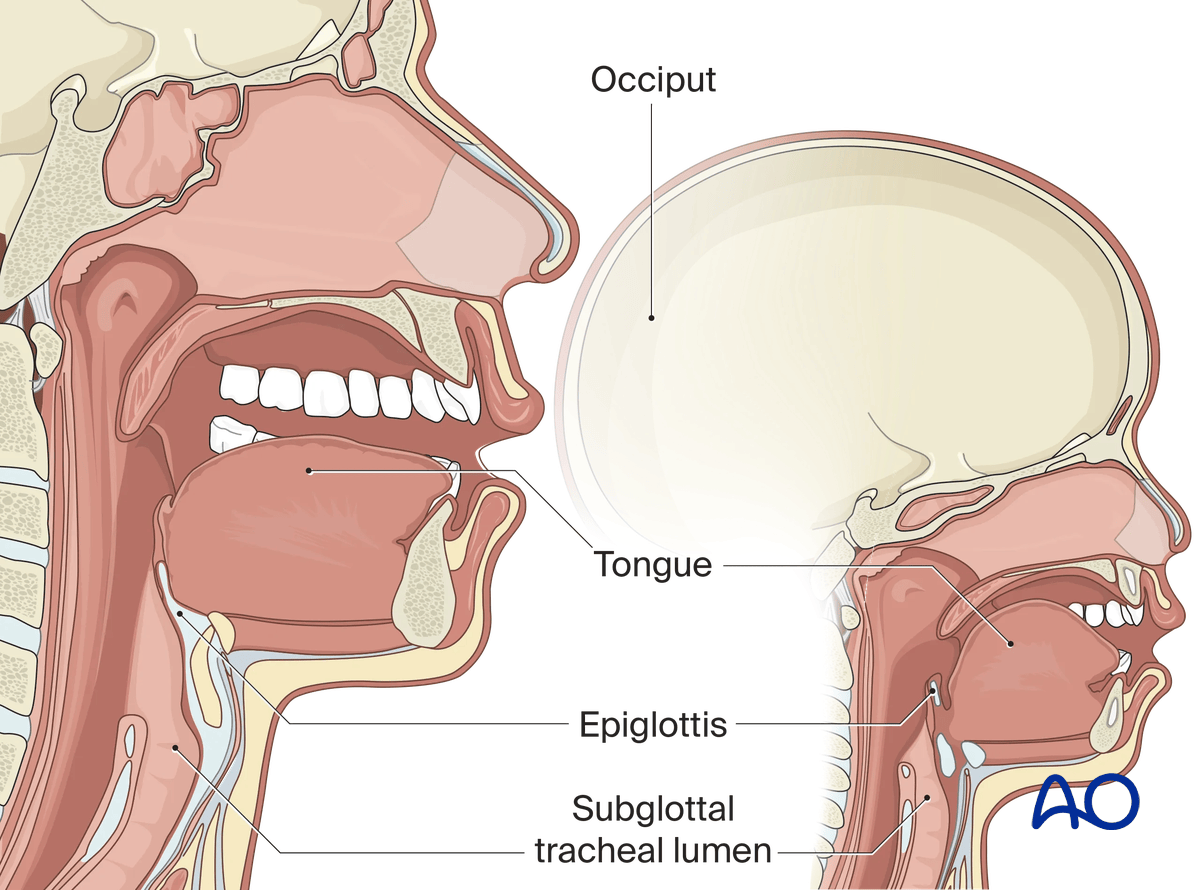
Children have a larger surface area ratio, reduced body fat, and less capacity to thermoregulate themselves. This applies especially for babies and toddlers. Immediate active rewarming is indicated during resuscitation or during anesthesia for fracture repair.
6. Pediatric specific injury patterns
Vulnerability to brain and spinal cord injuries
Babies, toddlers, and young children have disproportionately larger heads and weaker necks than adults. In the neck, the facet joints are more horizontal, and the soft tissues are more flexible. The consequences of these anatomic differences are increased vulnerability to brain and spinal cord injuries. With falls, a head strike and a traumatic brain injury occur more commonly in healthy children than in healthy adults. Deceleration injuries from motor vehicle crashes put the weaker neck at higher risk, particularly given the relatively large head size. Elasticity of the soft tissues in the neck can lead to complete spinal cord injury without any bony fracture (SCIWORA).
See also the chapter on Special considerations for more details on head and spinal cord injuries.
Fractures involving growth plates
Growth plates are involved in many pediatric fractures. The growth plates are robust and contribute to growth and remodeling that generally makes pediatric fracture care somewhat forgiving. However, growth arrest in a younger child can have significant and lifelong consequences. See chapter on Pediatric fracture classification.
7. References
- Calkins CM, Bensard DD, Moore EE, et al. The injured child is resistant to multiple organ failure: A different inflammatory response? J Trauma. 2002 Dec;53(6):1058–1063.
- Crump JM, Duncan DA, Wears R. Analysis of multiple organ system failure in trauma and nontrauma patients. Am Surg. 1988 Dec;54(12):702–708.
- Nahm NJ, Como JJ, Wilber JH, et al. Early appropriate care: Definitive stabilization of femoral fractures within 24 hours of injury is safe in most patients with multiple injuries. J Trauma. 2011 Jul;71(1):175–185.
- Pandya NK, Upasani VV, Kulkarni VA. The pediatric polytrauma patient: Current concepts. J Am Acad Orthop Surg. 2013 Mar;21(3):170–179.
- Proulx F, Gauthier M, Nadeau D et al. Timing and predictors of death in pediatric patients with multiple organ system failure. Crit Care Med. 1994 Jun;22(6):1025–1031.
- Tantaleán JA, León RJ, Santos AA, et al. Multiple organ dysfunction syndrome in children. Pediatr Crit Care Med. 2003 Apr;4(2):181–185.


