

ORIF - Lag screws through protection plate
1. Indications
For the treatment of simple spiral fractures in the diaphyseal area, absolute stability is an appropriate option. For this, anatomical reduction and interfragmentary compression are necessary. Interfragmentary compression is achieved with at least two lag screws, but the strength of this fixation is often insufficient for clinical use.
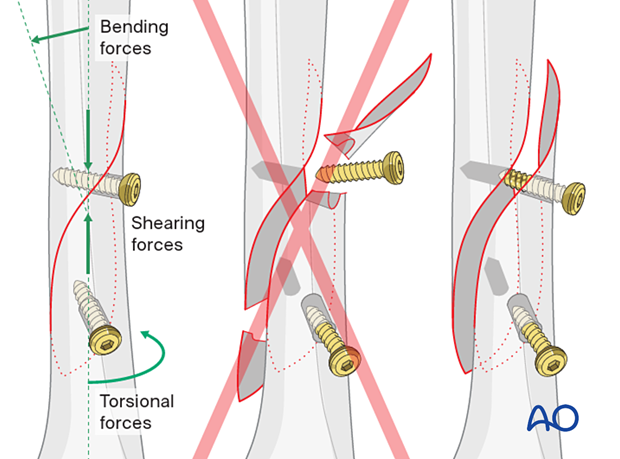
Bending, shearing, and torsional forces acting on an unprotected lag screw may cause screw loosening, loss of compression, or fracture of the bone. In order to protect the lag screw from these forces, a protection plate must be applied.
2. Preoperative planning
Screw position
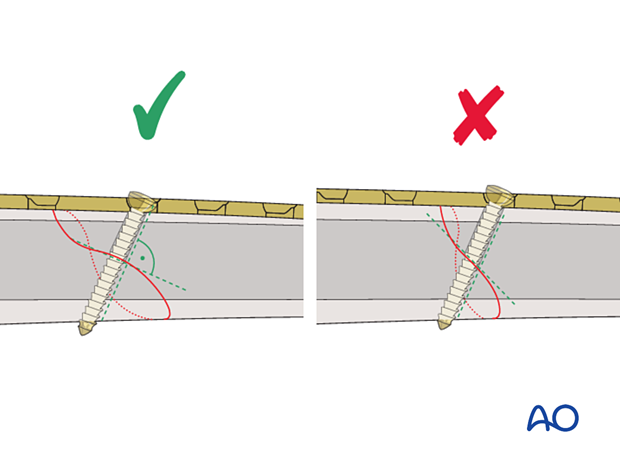
Lag screws should always be inserted as perpendicular as possible to the fracture plane where they cross it.
Lag screws inserted through a plate give better stability than screws outside of a plate. Whenever possible, plan the plate position so that one or two screws can be inserted through the plate and perpendicular to the fracture.
In some situations, one, or both, lag screws must be inserted outside of the plate, depending on fracture geometry and surgical access.
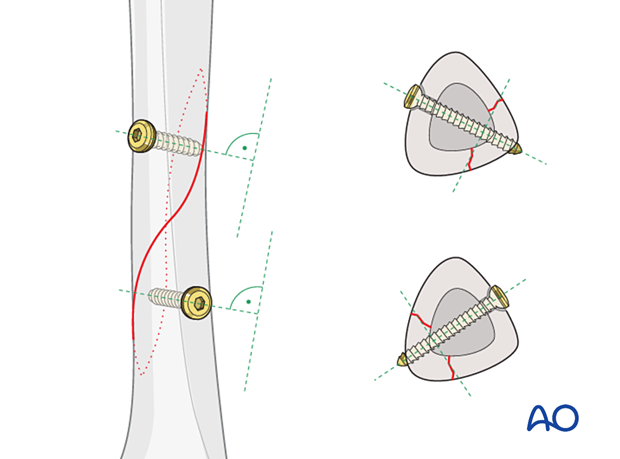
Plate location
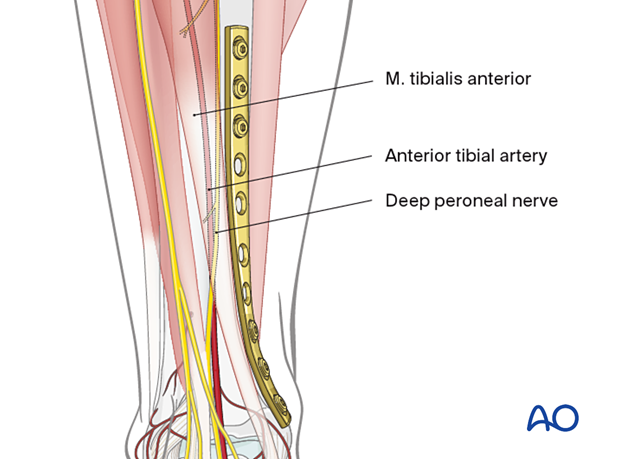
If the anteromedial skin is completely free of injury, a plate can be positioned on this tibial surface. When in doubt about the soft tissues, an anterolateral plate may have less risk of wound breakdown.
An anteromedial, subcutaneous plate does not require muscle elevation, as would be necessary anterolaterally. Furthermore, this location also allows a more distal position of the plate.
The plate should be long enough to span the fracture zone, usually with at least three screws proximal and distal to the fracture zone.
A narrow, large-fragment (4.5 mm screw) plate is usually chosen. It needs to be bent and twisted to fit the selected tibial surface.
3. Patient preparation and approaches
Patient preparation
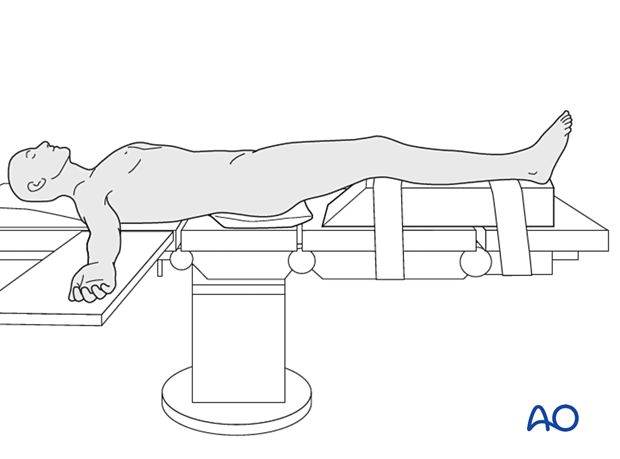
This procedure is normally performed with the patient placed in a supine position.
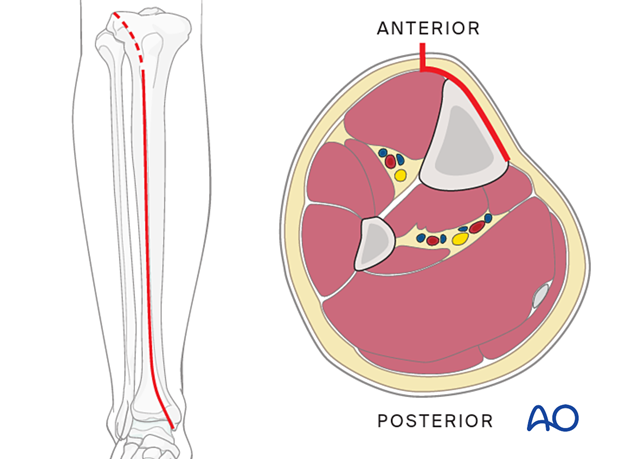
Anteromedial approach
An anteromedial approach can be used if the soft-tissue envelope allows. The advantage of this approach is that it removes no muscle from the fracture fragments. Also, the medial surface of the tibia is normally flat, and conventional plates can be contoured to fit it or precontoured plates used with minimal or no modification.
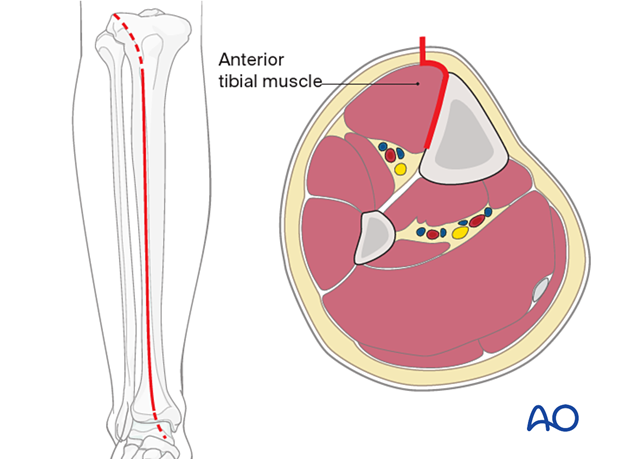
Anterolateral approach
The anterolateral approach can also be used if the plate is best placed on the lateral surface of the tibia. It can also be used when the medial soft tissues are compromised.
4. Open reduction
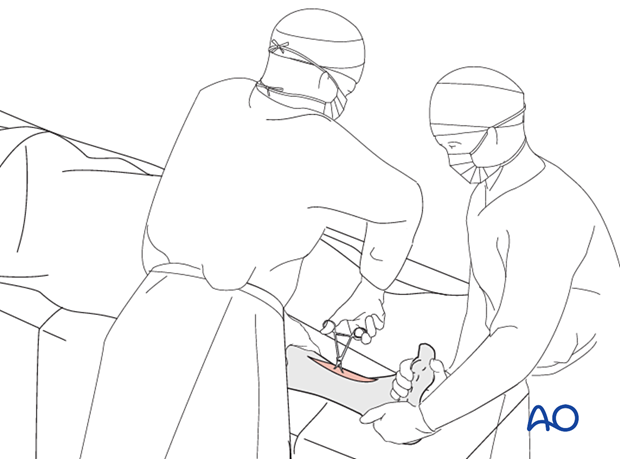
Introduction
Open, or direct, reduction is necessary to achieve the required anatomical reduction.
Mobilize just enough of the periosteum around the fracture edges to assess the quality of the reduction. Take care to protect the periosteum wherever possible.
Pointed reduction forceps are preferred because they do less damage to the soft tissues.
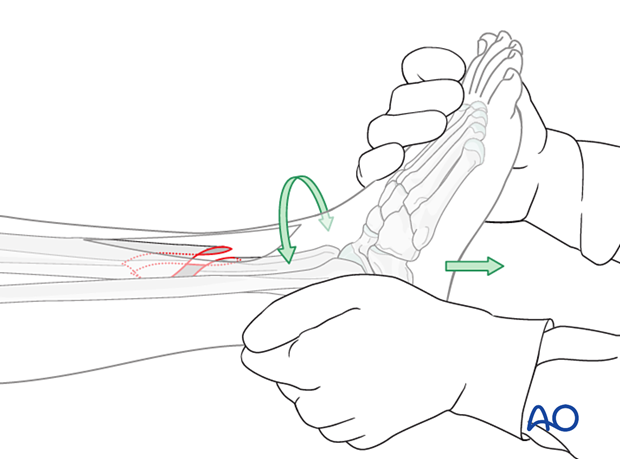
Manual traction
As a first step, length and rotation must be restored. This may be possible with manual traction. Otherwise, mechanical aids such as a large distractor, or bone spreader, should be considered.
Reduction of the fracture
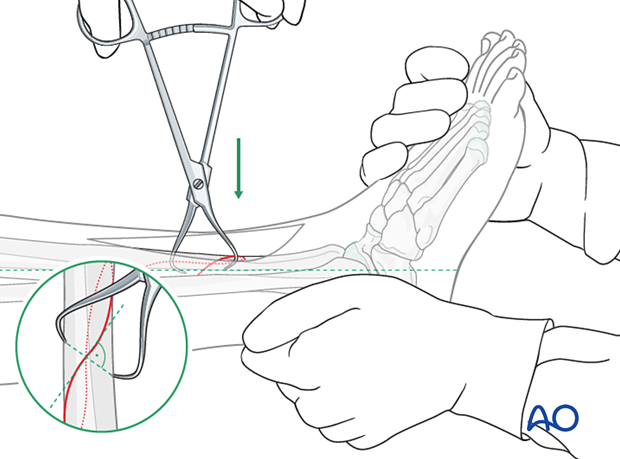
As a second step, once length and rotation are restored, pointed reduction forceps are used to compress and anatomically reduce the fracture. The tips of the forceps should be applied perpendicular to the plane of the fracture, just like a lag screw.
The forceps should not interfere with plate positioning. Anticipate where the plate will be positioned prior to applying the forceps.
Remember that the forceps can be positioned either medially or laterally. Choose the position that provides the most stability with the least additional soft-tissue damage.
5. Planning the plate position
Confirm fracture plane
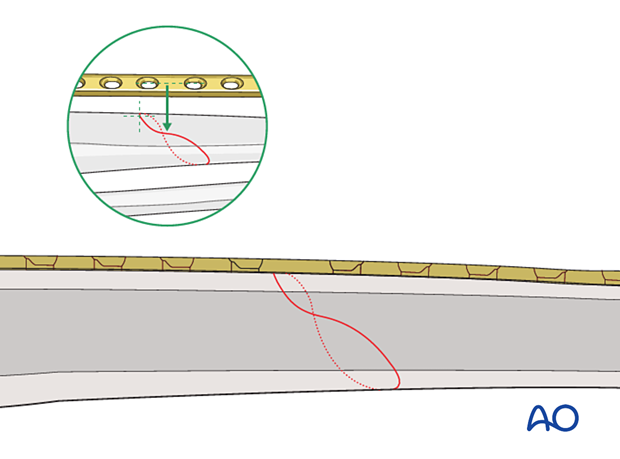
Confirm the fracture plane and ensure that the plate can be applied over the apex of the fracture. If this is possible, a compression plate construct with a lag screw through the plate will be used. If the apex of the fracture lies on the tibial crest, the lag screw must be inserted outside of the protection plate as a plate placed in this area will cause significant soft-tissue irritation.
Determine the plate position
Before starting the procedure, the exact position of the plate should be determined according to the position of the lag screw. The screw should be inserted perpendicular to the fracture plane.
6. Preparation
Plate selection and preparation
The chosen plate, usually a narrow, 4.5 mm dynamic compression plate (DCP), should provide the following:
- A hole near the middle of the fracture, for the first lag screw to be inserted as perpendicularly as possible to the fracture plane
- Sufficient length for at least 3 screws proximal and distal to the fracture zone
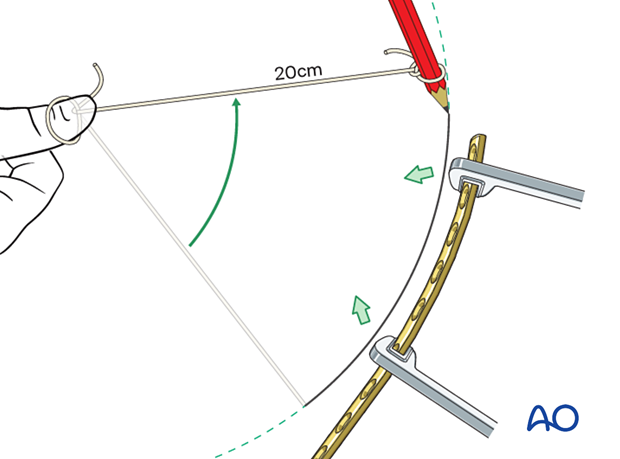
Usually a 10–12 hole straight 4.5 mm DCP is used. Remember that whenever the plate is placed distally, it must be twisted and bent to match the shape of the tibia in that region.
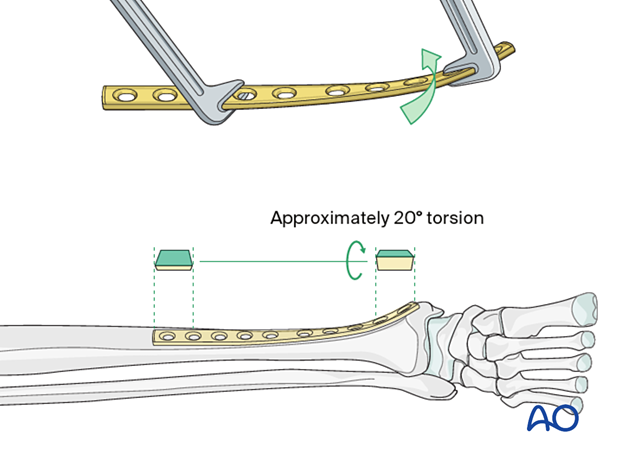
When placed distally the bend of the plate is usually a 20 cm radius, and the twist is approximately 20°.
7. Fixation
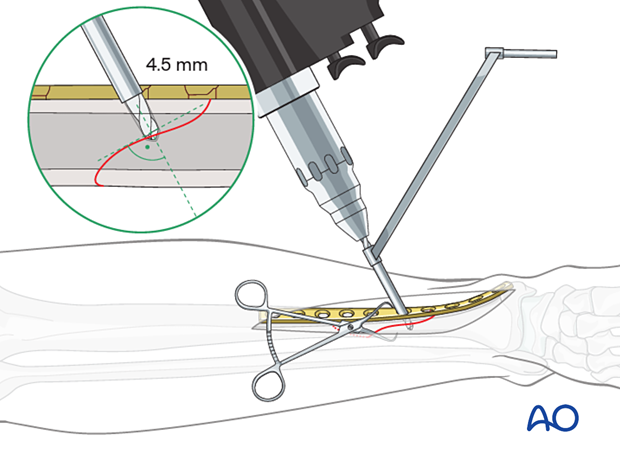
Drill the gliding hole for the lag screw
Place the contoured plate onto the bone.
Using a 4.5 mm drill guide and a 4.5 mm drill bit, drill a gliding hole in the near cortex.
Ensure that the direction of the drill is as perpendicular to the fracture plane as possible, and the plate is properly positioned on the bone.
More information about lag screw insertion is provided here: Cortical lag screw insertion
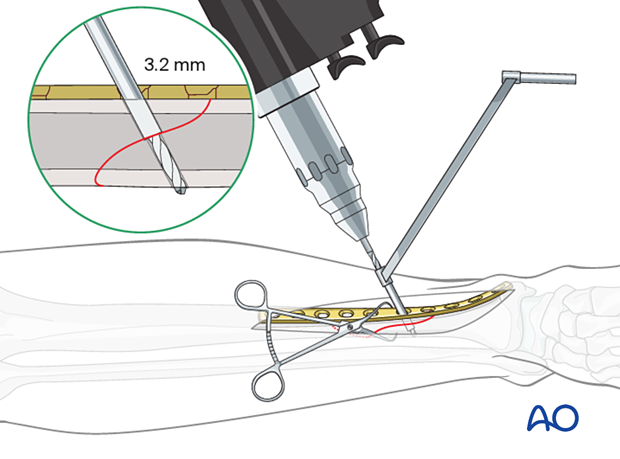
Drill the thread hole
Insert the 4.5 mm/3.2 mm drill guide through the plate and into the gliding hole. Use a 3.2 mm drill bit to drill a thread hole just through the far cortex.
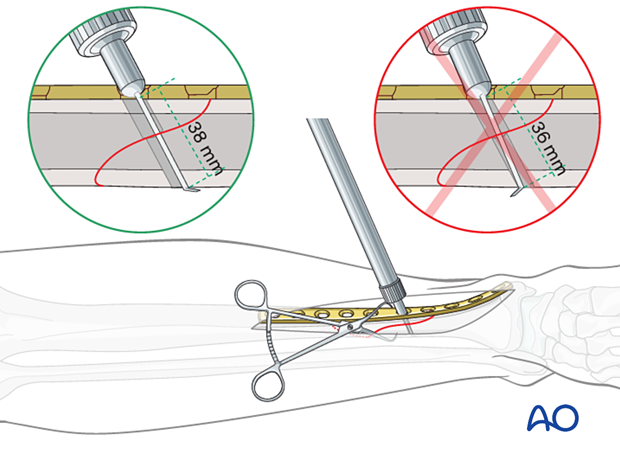
Measure for screw length
Use a depth gauge through the plate to measure for screw length.
Measure the longer side of an oblique drill hole, as shown, to ensure sufficient screw length.
A screw should protrude 1–2 mm through the opposite cortex to ensure thread purchase. If a screw is too long, it may irritate the surrounding soft-tissue envelope in which the tip protrudes.
Tap the thread hole
Use a 4.5 mm tap and the corresponding drill sleeve to tap the thread hole (if self-tapping screws are not used).
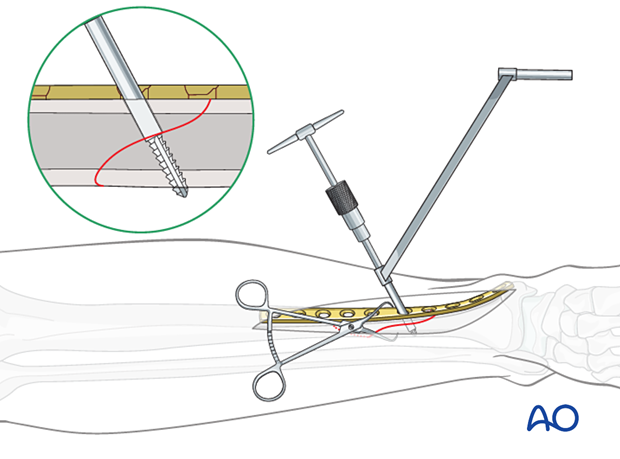
Insert the first lag screw
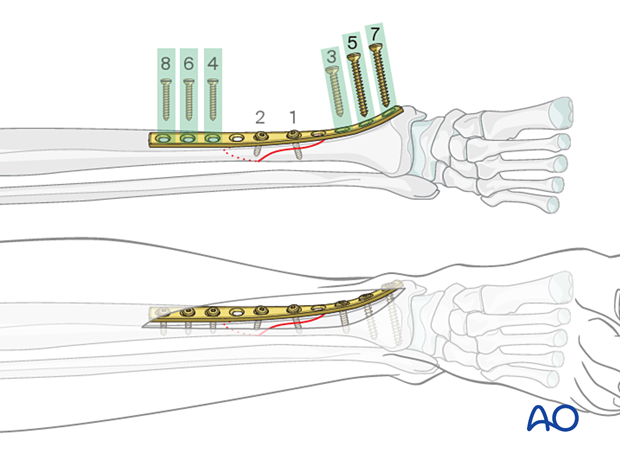
Insert the first lag screw through the plate and carefully tighten it, making sure that the fracture stays reduced, is compressed, and the plate is approximated to the tibial surface.
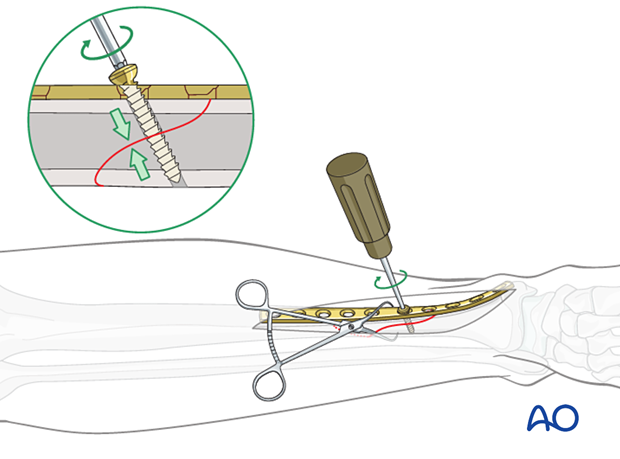
Insert the second lag screw
Insert the second lag screw following the same steps as for the first lag screw. If a 4.5 mm screw is chosen:
- Drill the gliding hole with a 4.5 mm drill bit and drill guide. The hole should be as perpendicular to the fracture plane as possible.
- Insert the 4.5 mm/3.2 mm drill guide into the gliding hole.
- Drill the thread hole with a 3.2 mm drill bit.
- Measure for length.
- Tap the thread hole with a 4.5 mm tap.
- Insert the screw.
Due to the geometry of spiral fractures, the second lag screw may not be perfectly perpendicular to the fracture plane. The stability gained by inserting the screw through the plate outweighs this slight disadvantage.
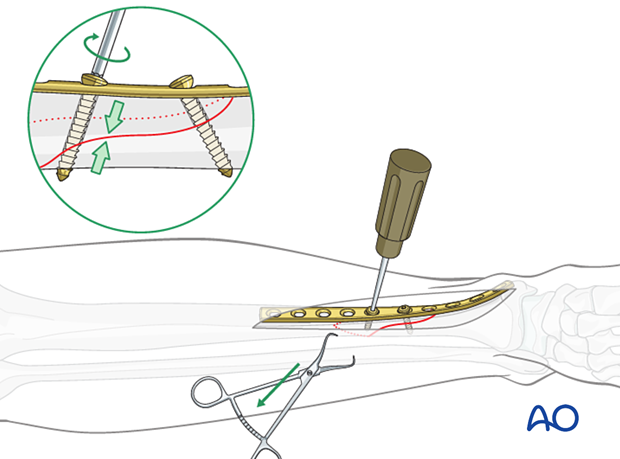
Insert diaphyseal fixation screws
Insert the screws alternating between the proximal and distal fragments. Start with the screws closest to the fracture and work outwards.
At least three screws should be used on the proximal fragment, and at least three screws on the distal fragment. Not every hole needs to be filled, but the screws closest to and furthest from the fracture are the most important.
In the diaphyseal bone, use cortical screws. Cancellous screws can be used in the metaphysis.
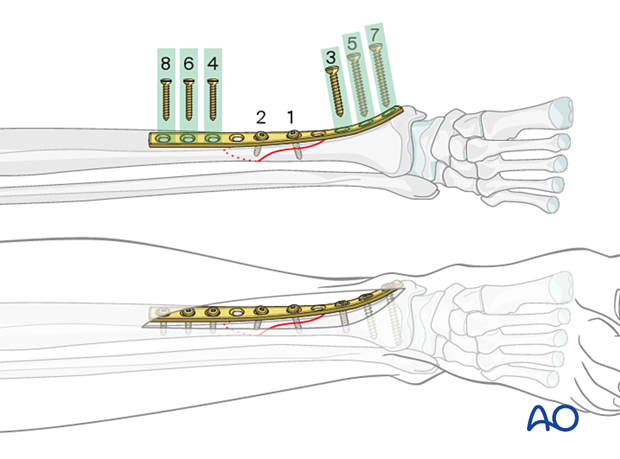
Insert metaphyseal fixation screws
If cancellous screws are used in the metaphysis, observe the following steps:
- Drill with the appropriate drill bit and DCP drill guide to ensure a central drill hole. Do not penetrate the far cortex (or the joint).
- Measure for screw length.
- Tap just the near cortex using the appropriate tap and drill sleeve.
- Insert cancellous screws and carefully tighten them.
Metaphyseal screws should be as long as possible but must not penetrate the far cortex, or the joint.
8. Aftercare
Perioperative antibiotics may be discontinued before 24 hours.
Attention is given to:
- Pain control
- Mobilization without early weight bearing
- Leg elevation in the presence of swelling
- Thromboembolic prophylaxis
- Early recognition of complications
Soft-tissue protection
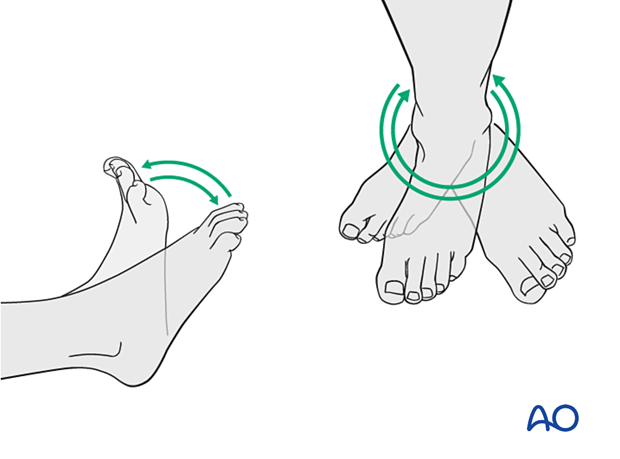
A brief period of splintage may be beneficial for protection of the soft tissues but should last no longer than 1–2 weeks. Thereafter, mobilization of the ankle and subtalar joints should be encouraged.
Mobilization
Active, active assisted, and passive motion of all joints (hip, knee, ankle, toes) may begin as soon as the patient is comfortable. Attempt to preserve passive dorsiflexion range of motion.
Weight bearing
For fractures treated with plating techniques, limited weight bearing (15 kg maximum), with crutches, may begin as tolerated, but full weight bearing should be avoided until fracture healing is more advanced (8–12 weeks).
For fractures treated with intramedullary nailing, weight bearing as tolerated, with crutches, may begin immediately.
Follow-up
Follow-up is recommended after 2, 6, and 12 weeks and every 6–12 weeks thereafter until radiographic healing and function are established. Weight bearing can be progressed after 6–8 weeks when x-rays have indicated that the fracture has shown signs of progressive healing.
Implant removal
Implant removal may be necessary in cases of soft-tissue irritation caused by the implants. The best time for implant removal is after complete bone remodeling, usually at least 12 months after surgery. This is to reduce the risk of refracture.


