

ORIF - Compression plate with lag screw
1. Principles
For the treatment of simple oblique fractures in the diaphyseal area, an absolute stability plate construct can be considered.
For this, direct anatomical reduction and interfragmentary compression are necessary.
Choosing the method of interfragmentary compression
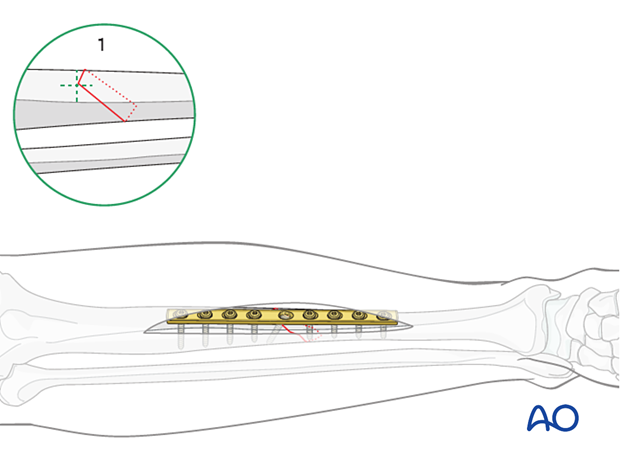
The method of interfragmentary compression is determined by the fracture geometry and the plane of the obliquity.
In example one, shown here, the apex of the fracture is in the center of the anteromedial or anterolateral surface of the tibia.
In this case, the fracture can be compressed with a compression plate with a supplementary lag screw through the plate.
The apex of the fracture should be underneath the plate.
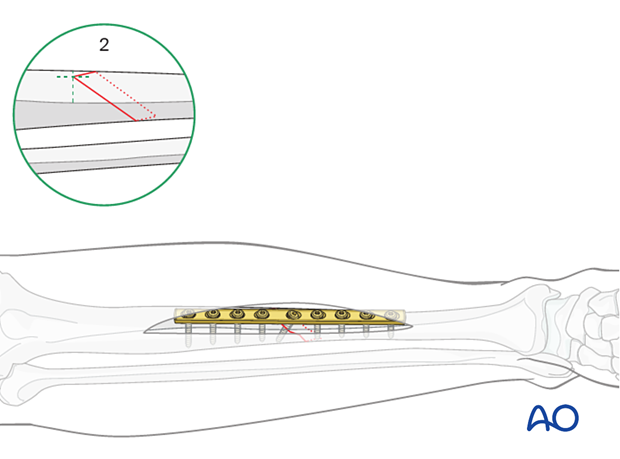
In example two, shown here, the apex of the fracture is not in the center of the anteromedial or anterolateral surface, but is either posterior or anterior.
In this case, compression must be done with a lag screw, inserted either inside or outside the plate. In this case, the plate is used in protection rather than compression mode. The apex of the fracture is not underneath the plate but is either anterior or posterior to it.
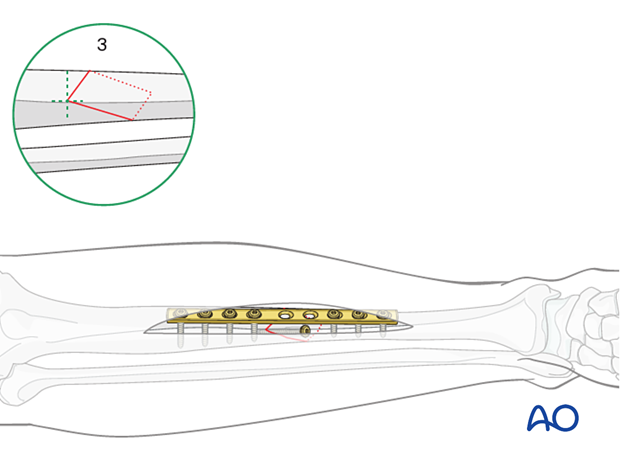
In example three, shown here, the apex of the fracture lies on the tibial crest.
In this case, a lag screw outside of the plate (applied in protection mode) is usually required.
2. Patient preparation and approaches
Patient preparation
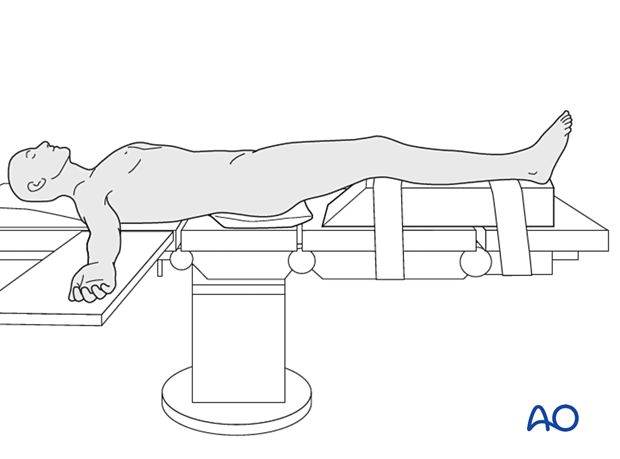
This procedure is normally performed with the patient placed in a supine position.
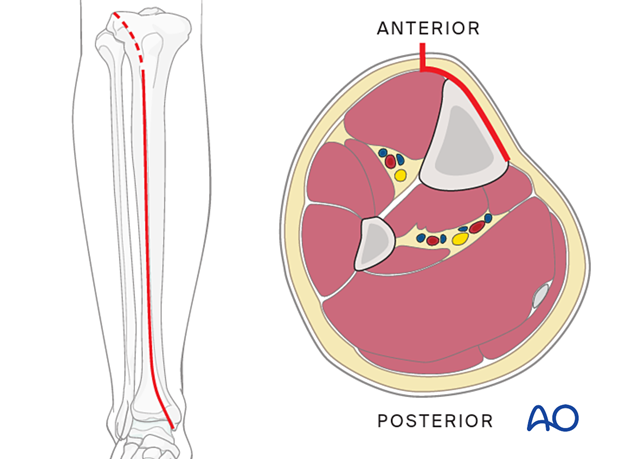
Anteromedial approach
An anteromedial approach can be used if the soft-tissue envelope allows. The advantage of this approach is that it removes no muscle from the fracture fragments. Also, the medial surface of the tibia is normally flat, and conventional plates can be contoured to fit it or precontoured plates used with minimal or no modification.
Anterolateral approach
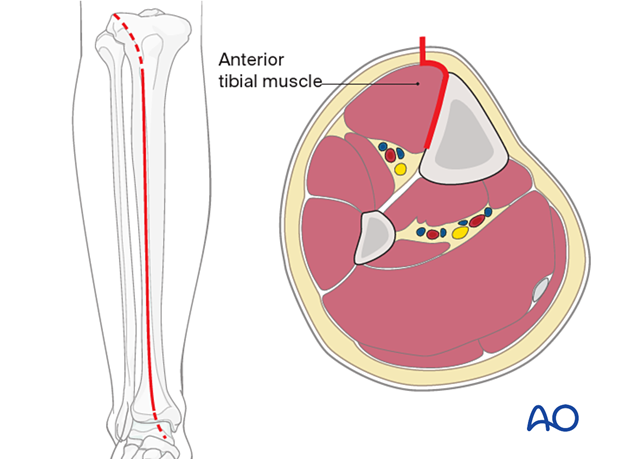
The anterolateral approach can also be used if the plate is best placed on the lateral surface of the tibia. It can also be used when the medial soft tissues are compromised.
3. Open reduction
Introduction
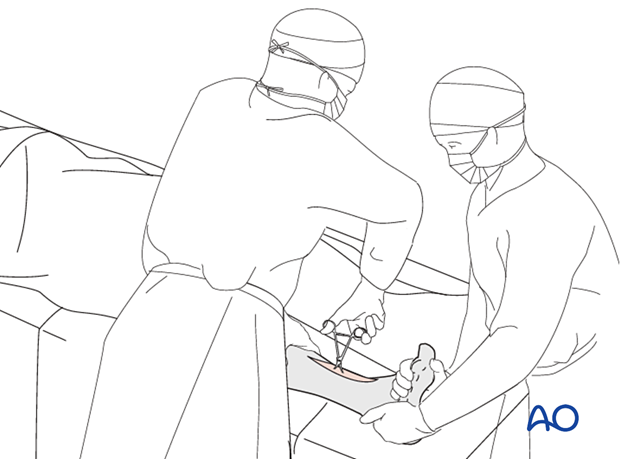
As anatomical reduction is necessary, open, or direct, reduction is needed.
Mobilize just enough of the periosteum around the fracture edges to assess the quality of the reduction. Leave as much of the periosteum as possible on the rest of the bone.
Pointed reduction forceps are preferred because they do less damage to the soft tissues.
Manual traction
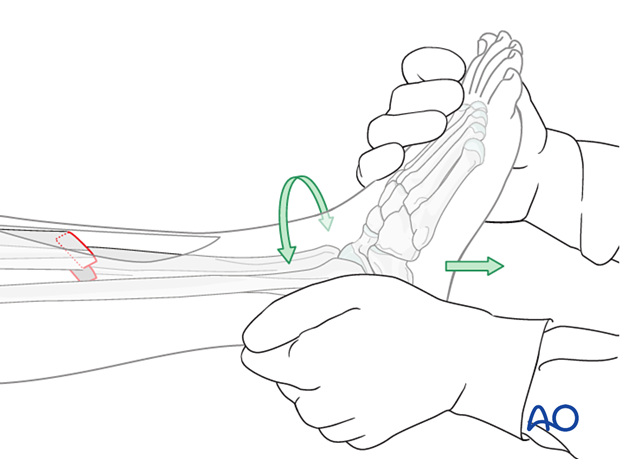
As a first step, length and rotation must be restored. This may be possible with manual traction. Otherwise, mechanical aids such as a large distractor, or bone spreader, should be considered.
Reduction of the fracture
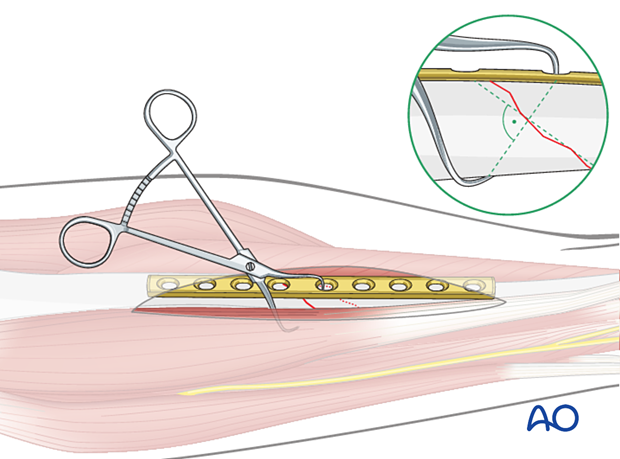
As a second step, once length and rotation are restored, pointed reduction forceps are used to compress and anatomically reduce the fracture. The tips of the forceps should be applied perpendicular to the plane of the fracture, just like a lag screw. Place the forceps outside the intended path of the lag screw.
Alternative: indirect reduction with the plate
In minimally displaced fractures, the fracture can be reduced with the plate. To do this, follow these steps:
- Determine the position of the plate as described above.
- Drill the first hole as close as possible to the fracture line, using a 3.2 mm drill bit. (Alternatively, this hole can be drilled before fracture reduction.)
- Measure for screw length using a depth gauge.
- Apply the plate and tighten the screw.
This usually reduces the fracture.
4. Confirm fracture plane
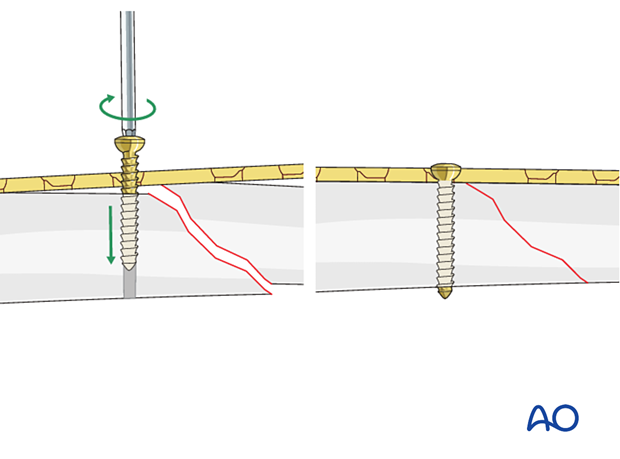
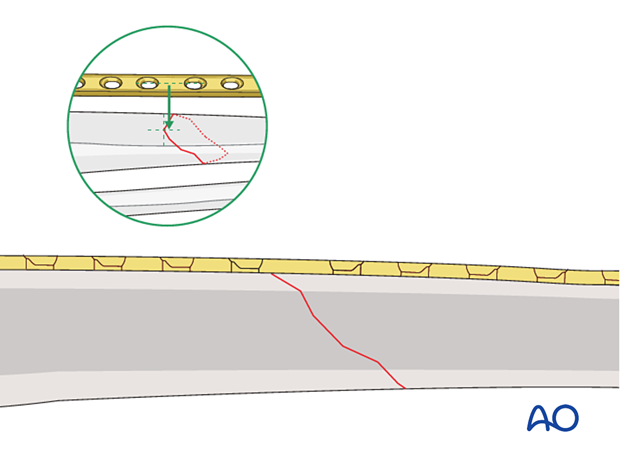
Before starting with this fixation method, be sure that the plate can be placed exactly over the apex of the fracture. This is only possible if the fracture apex is centered on the tibial surface where the plate will be placed.
5. Preparation
Plate selection and preparation
The chosen plate, usually a narrow, 4.5 mm dynamic compression plate (DCP), should allow:
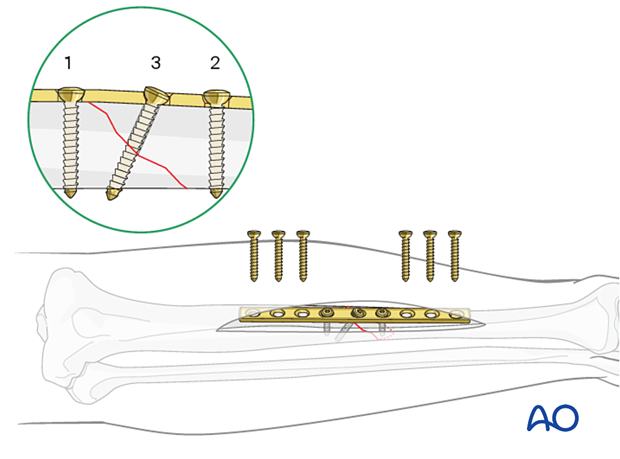
- Screws 1 and 2 to be placed proximal and distal of the fracture, and screw 3 to be placed centrally and perpendicular to the fracture, as illustrated.
- At least 3 additional screw holes proximal, and 3 screw holes distal to the fracture site.
Usually a 9–10 hole straight, narrow 4.5 mm DCP is used.
Remember that whenever the plate is placed distally, it must be twisted and bent to match the shape of the tibia in that region.
Planning the plate position
Before starting the procedure, the location of the plate (proximal/distal) is determined according to the following:
- The position of the first screw in relation to the fracture apex. The first screw must be placed as close as possible to the fracture (screw 1 in the illustration).
- The position of the lag screw (screw 3 in the illustration). The lag screw should be inserted as perpendicular as possible to the fracture plane.
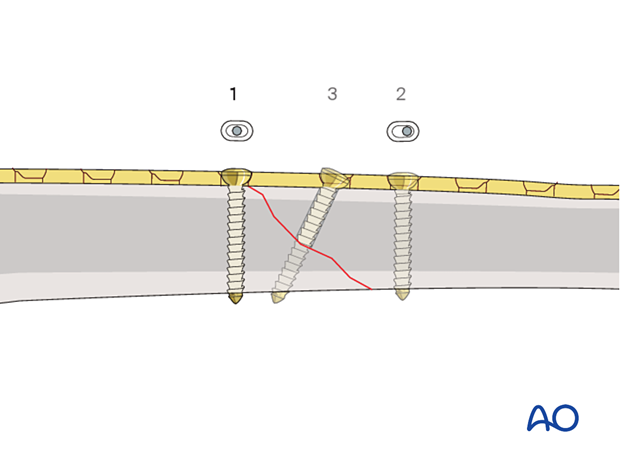
Overbending the plate
To compress the opposite cortex, the plate should be slightly overbent (more convex) at the fracture, so there is a small gap between plate and bone. This causes the cortex opposite the plate to be compressed first, as the eccentrically placed plate screws are tightened. With further tightening, the near cortex of the fracture becomes compressed. This short, convex (away from the bone) bend can be made with handheld bending pliers or a pair of bending irons.
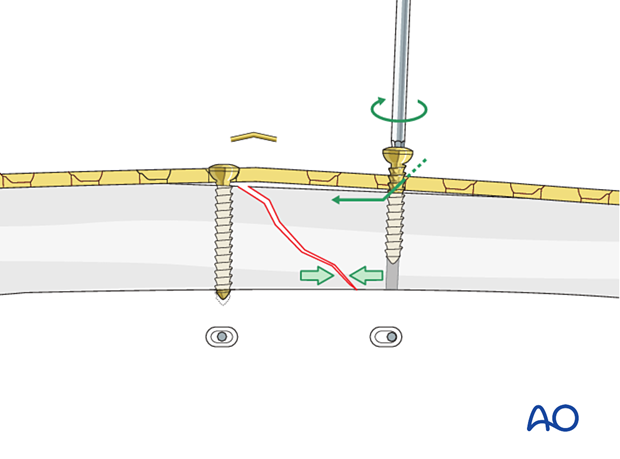
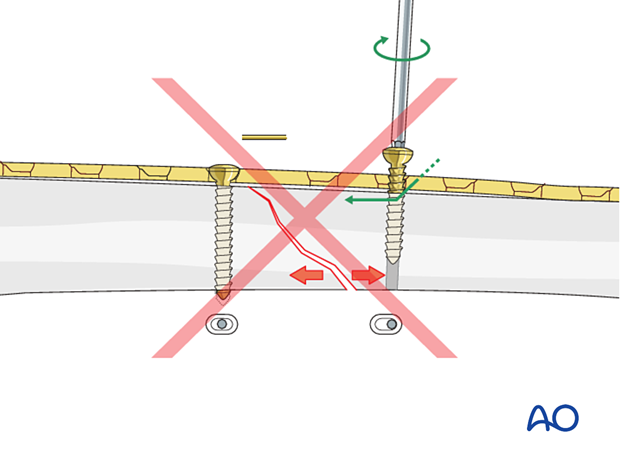
If axial compression is applied in a transverse or short oblique fracture with a plate that is not overbent, compression first occurs at the cortex under the plate. This causes a gap in the fracture opposite the plate, resulting in instability. Such a gap must be avoided.
6. Fixation
Planning the first screw
An oblique fracture line forms an obtuse angle and an acute angle under the plate, as illustrated in this AP view.
The plate must be attached first to the bone fragment which forms the obtuse angle. Thus, the plate prevents displacement along the fracture plane.
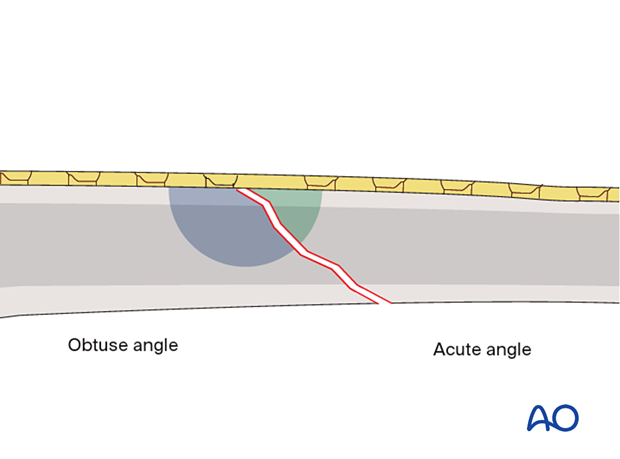
The first screw is inserted on the side of the plate where the fracture forms an obtuse angle with the plate. This forms a space between the plate and fracture line into which the acute-angle fragment fits. This will prevent excessive shortening during compression.
When compression is applied by tightening the second (eccentric) screw on the opposite side of the fracture, the plate traps the distal fragment as illustrated and converts axial compression to fracture plane compression.
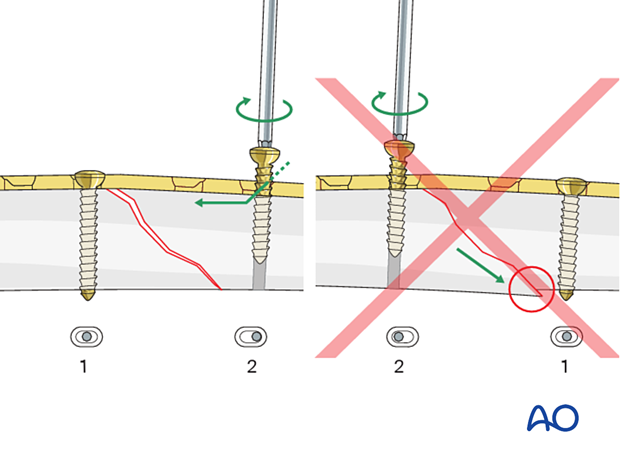
Insert the first screw
Drill with a 3.2 mm drill bit and neutral drill guide through the plate hole as close as possible to the apex of the fracture. Measure for screw length and insert the first screw, but do not fully tighten it yet.
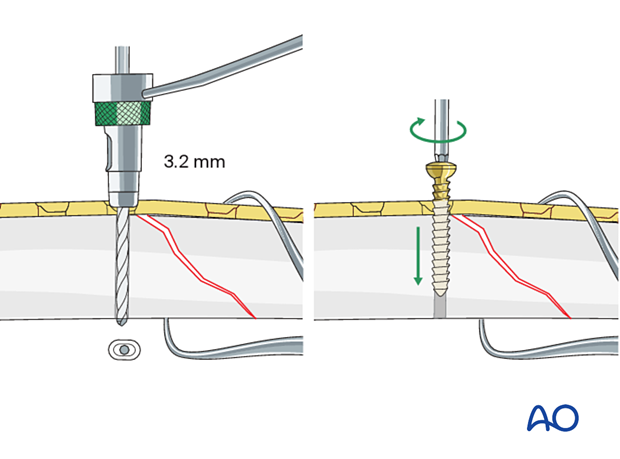
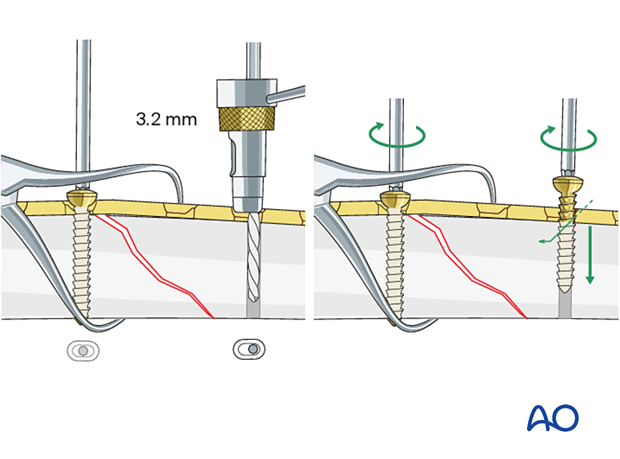
Axial compression with eccentric screw
Now, with the fracture reduced and the plate properly positioned, drill eccentrically (load position) for the second screw. Then measure for screw length. Insert the eccentric screw and alternately tighten both screws, compressing the fracture.
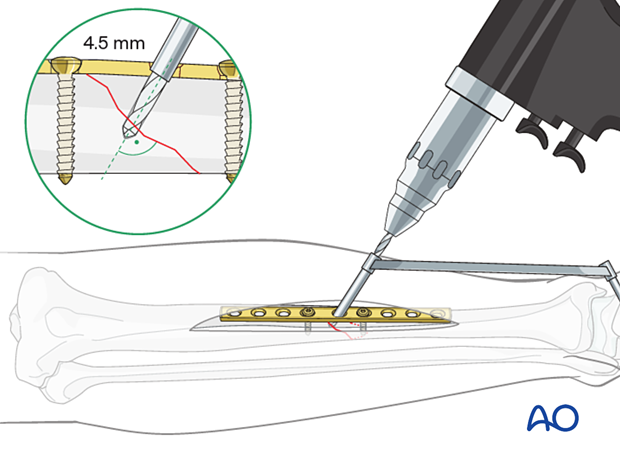
Drill the gliding hole for the lag screw
Using a 4.5 mm drill guide and a 4.5 mm drill bit, drill a gliding hole in the near cortex.
Ensure that the direction of the drill is as perpendicular to the fracture plane as possible.
More information about lag screw insertion is provided here:
Drill the thread hole
Insert the 4.5 mm/3.2 mm drill guide through the plate and into the gliding hole. Use a 3.2 mm drill bit to drill a thread hole just through the far cortex.
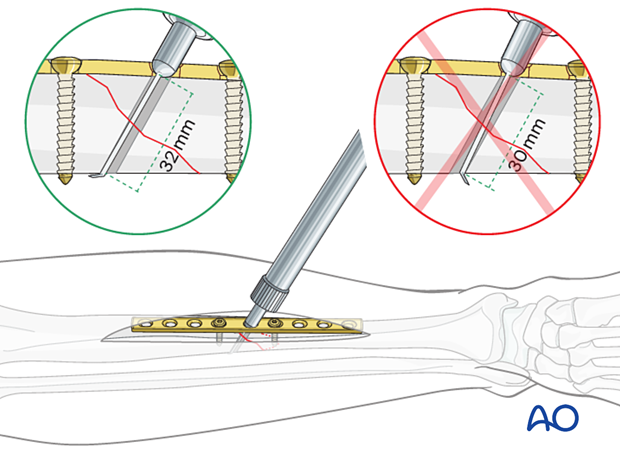
Measure for screw length
Use a depth gauge through the plate to measure for screw length.
Measure the longer side of an oblique drill hole, as shown, to ensure sufficient screw length.
A screw should protrude 1–2 mm through the opposite cortex to ensure thread purchase. If a screw is too long, it may irritate the surrounding soft-tissue envelope in which the tip protrudes.
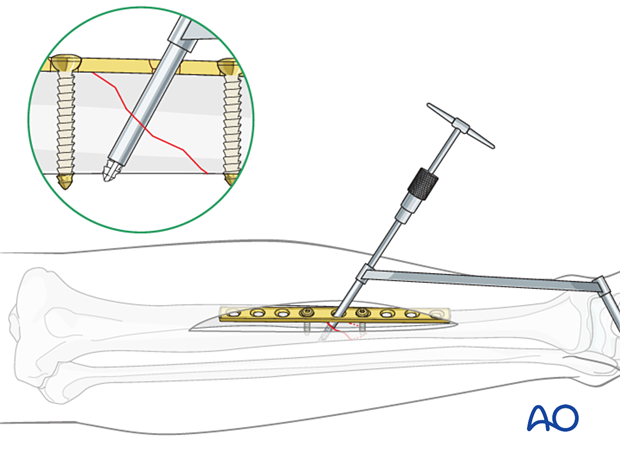
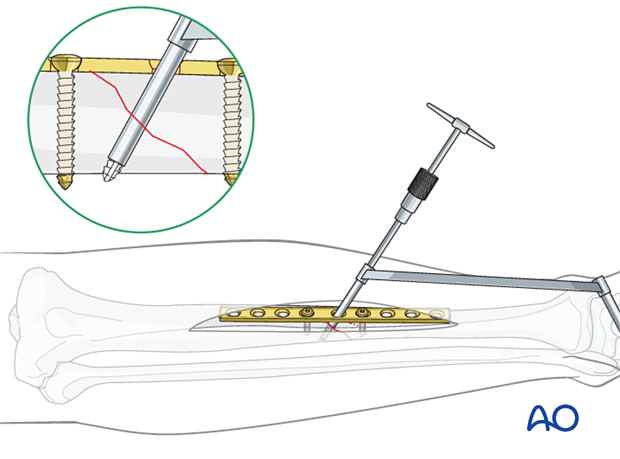
Tap the thread hole
Use a 4.5 mm tap and the corresponding drill sleeve to tap the thread hole (if self-tapping screws are not used).
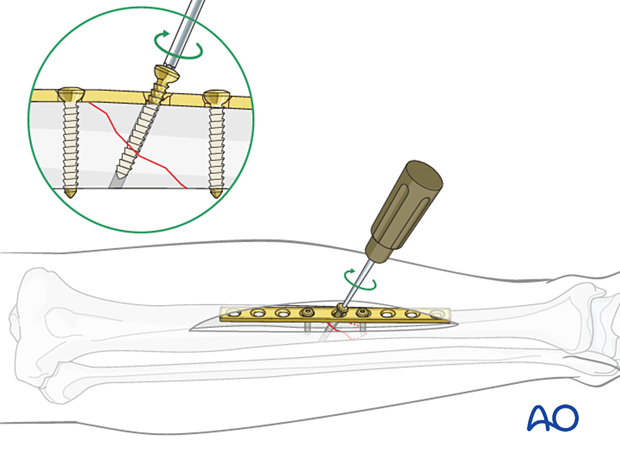
Insert the lag screw
Insert the lag screw and carefully tighten it.
This increases both the compression and the stability of the construct.
Insert diaphyseal fixation screws
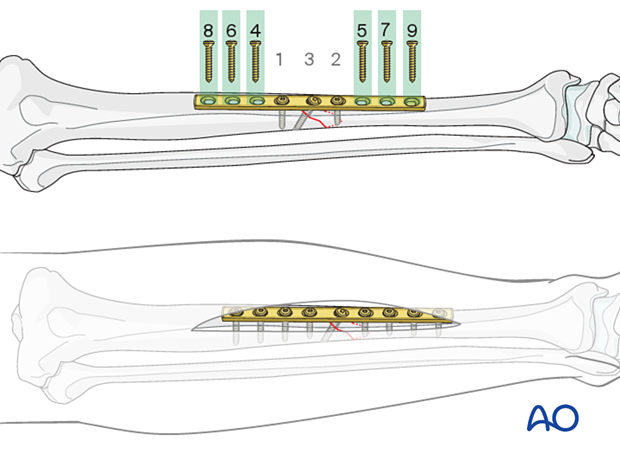
Insert the screws alternating between the proximal and distal fragments. Start with the screws closest to the fracture plane and work outwards.
At least three screws should be used on the proximal fragment and at least three screws on the distal fragment.
For diaphyseal fixation, use cortical screws.
7. Aftercare
Perioperative antibiotics may be discontinued before 24 hours.
Attention is given to:
- Pain control
- Mobilization without early weight bearing
- Leg elevation in the presence of swelling
- Thromboembolic prophylaxis
- Early recognition of complications
Soft-tissue protection
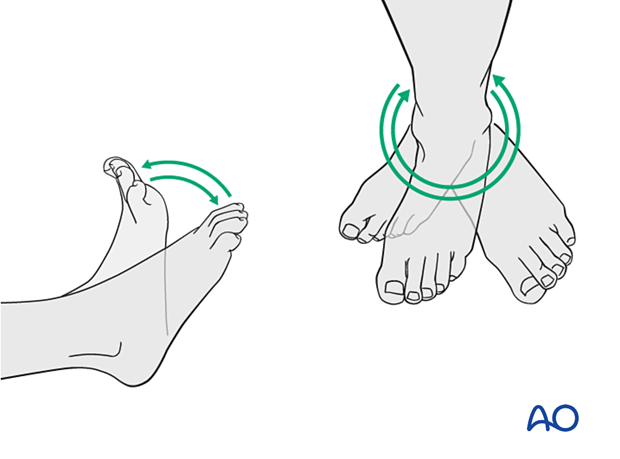
A brief period of splintage may be beneficial for protection of the soft tissues but should last no longer than 1–2 weeks. Thereafter, mobilization of the ankle and subtalar joints should be encouraged.
Mobilization
Active, active assisted, and passive motion of all joints (hip, knee, ankle, toes) may begin as soon as the patient is comfortable. Attempt to preserve passive dorsiflexion range of motion.
Weight bearing
For fractures treated with plating techniques, limited weight bearing (15 kg maximum), with crutches, may begin as tolerated, but full weight bearing should be avoided until fracture healing is more advanced (8–12 weeks).
For fractures treated with intramedullary nailing, weight bearing as tolerated, with crutches, may begin immediately.
Follow-up
Follow-up is recommended after 2, 6, and 12 weeks and every 6–12 weeks thereafter until radiographic healing and function are established. Weight bearing can be progressed after 6–8 weeks when x-rays have indicated that the fracture has shown signs of progressive healing.
Implant removal
Implant removal may be necessary in cases of soft-tissue irritation caused by the implants. The best time for implant removal is after complete bone remodeling, usually at least 12 months after surgery. This is to reduce the risk of refracture.


