

Bridge plating
1. Principles
Bridge plating
Multifragmentary diaphyseal fractures are usually best treated with relative stability techniques, such as intramedullary (IM) nailing, bridge plating, or, occasionally, external fixation.
Bridge plating uses the plate as an internal, extramedullary splint, fixed to proximal and distal intact fragments. The intermediate fracture zone is left untouched, bypassed by the plate. Anatomical reduction of comminuted wedge fragments is not necessary. Direct exposure injures the soft-tissue attachments, which provide blood supply and aid realignment when length is restored.
When soft-tissue attachments are preserved, fracture healing is predictable.
Correction of length, rotation, and axial alignment of the main shaft fragments can usually be achieved indirectly, using traction and soft-tissue tension.
Relative fracture-site stability, provided by the bridge plate, supports indirect healing (callus formation).
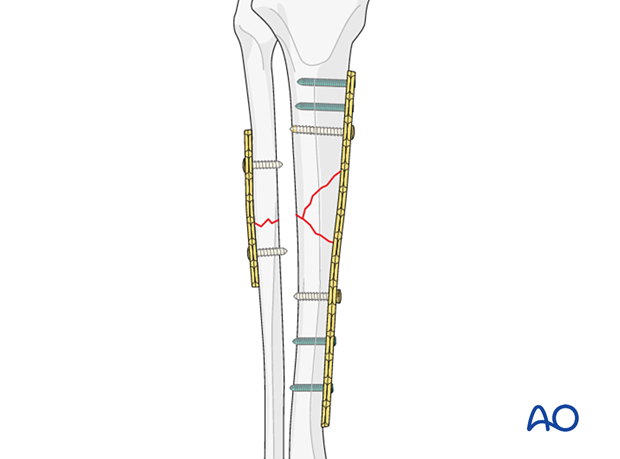
Bridge plate insertion
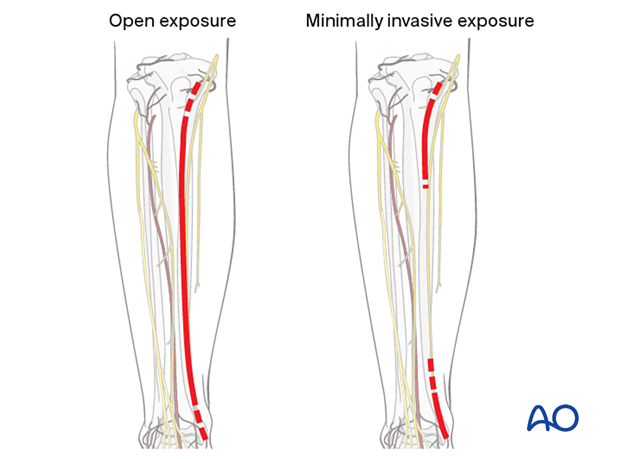
Bridge plates can be inserted, as illustrated, either with an open exposure that carefully preserves soft-tissue attachments to the fracture fragments, or with a minimally invasive approach that leaves skin and soft tissue intact over the fracture site.
With the minimally invasive osteosynthesis (MIO) approach, incisions are made proximally and distally, and the plate is inserted through an extraperiosteal tunnel. Such minimally invasive plating should be done using image intensification (if available).
Reduction
It is important to restore length, axial alignment, and rotation.
In some cases, a large fragment can displace with a sharp end impaling the adjacent muscle. The widely displaced fragment should be repositioned either directly or indirectly. Be careful to preserve the soft-tissue attachments.
2. Patient preparation and approaches
Patient preparation
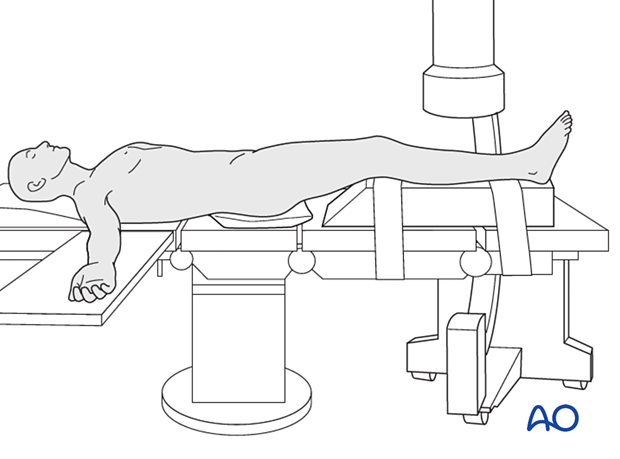
The patient is placed in a supine position on a radiolucent table or a standard operating table with a radiolucent extension. A pad is placed underneath the buttock to prevent external rotation.
A large foam bolster or cushion is placed under the affected leg to raise it above the opposite leg and facilitate lateral C-arm images.
Medial approach
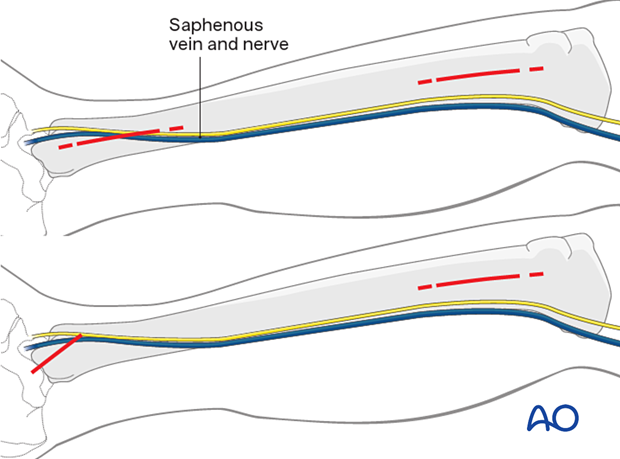
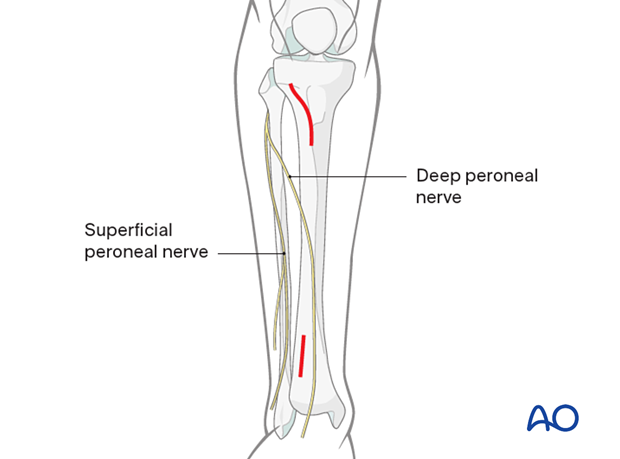
Fixation of tibial fractures is preferably done through the medial approach, especially for distal fractures.
For the MIO technique, the use of an image intensifier can allow the surgeon to use smaller incisions to insert the plate and screws.
Lateral approach
The lateral approach is used if the medial soft tissues are injured.
This approach is also used when a precontoured plate is placed laterally for fixation of proximal and mid-tibial fractures.
For the MIO technique, the use of an image intensifier can allow the surgeon to use smaller incisions to insert the plate and screws.
3. Reduction
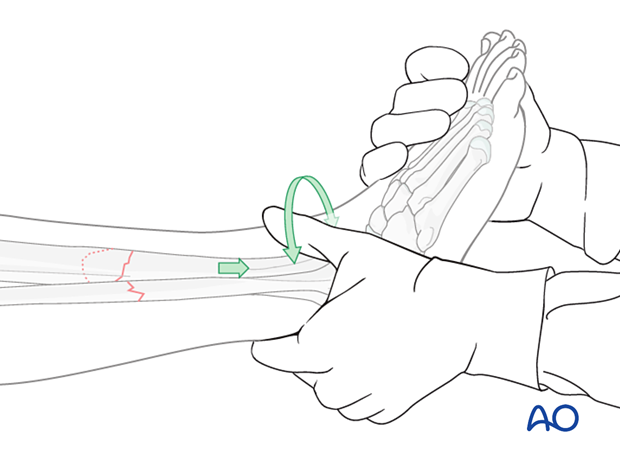
Manual traction
It is important to restore length, axial alignment, and rotation.
Apply longitudinal traction to the foot to restore length. When length is restored, correct the axial and rotational alignment.
Compare length, alignment, and rotation with the uninjured side.
Reduction aids
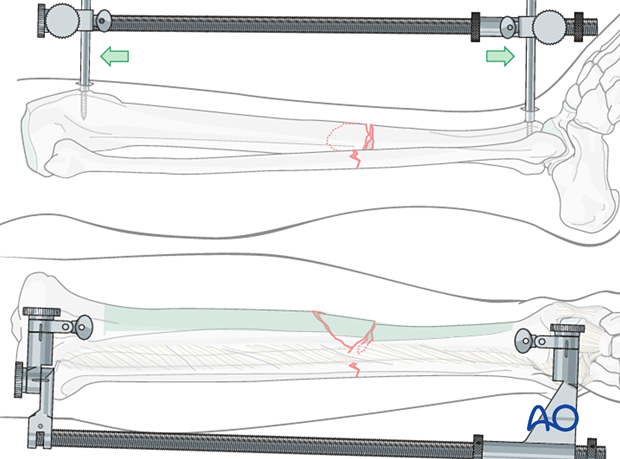
If reduction cannot be achieved by manual traction, use a large distractor for closed reduction. Place one Schanz pin in both the proximal and distal main fragments. Distraction is applied across these pins by turning the thumb screw.
If a distractor is not available, an external fixator can be used instead.
Check reduction, and if necessary, correct rotational deformity.
4. Plate selection and preparation
Choice of implant
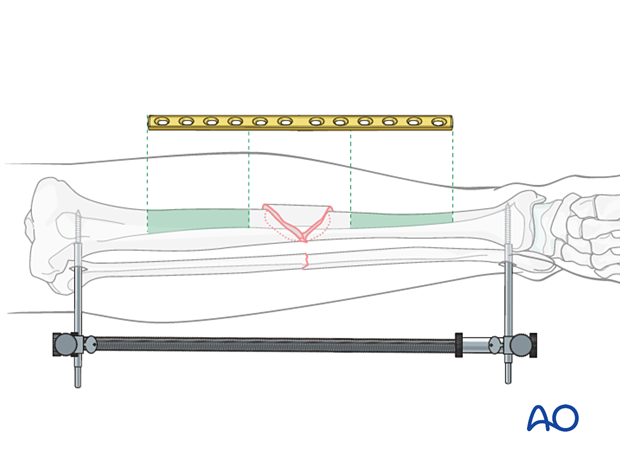
As bridge plating should span a long section of the bone, the length of the implant has to be chosen accordingly. A good rule of thumb is to calculate that one third of the plate should cover the fracture zone, with one third of the length on either side of the fracture. Usually, a narrow large fragment plate is chosen.
An angular stable (locking) plate is a good option in osteoporotic bone, and for fractures with a short end segment. Although it can be helpful, such a plate needs not to be contoured precisely to fit the bone, since it functions as an internal fixator. Attaching it to the bone does not alter fracture alignment, since the screws do not pull the main bone fragments to the plate.
Contouring the plate
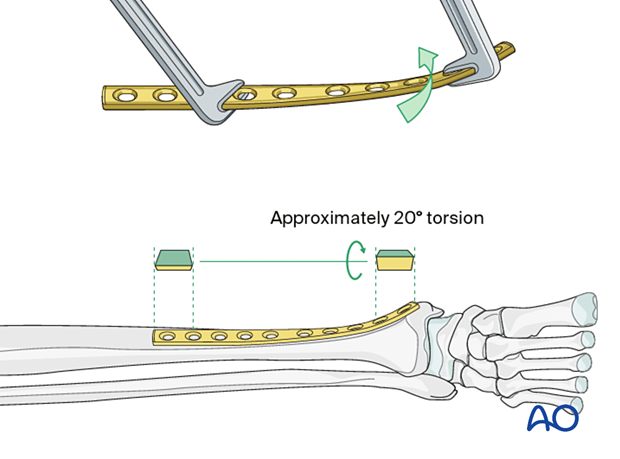
The anteromedial surface of the tibial shaft twists internally approximately 20° as it approaches the medial malleolus.
The first step of plate contouring is to twist the plate so it matches the tibial surface upon which it will lie.
If the plate is bent before it is twisted, the process of twisting will alter the bend that has been created.
5. Definitive fixation
Plate insertion
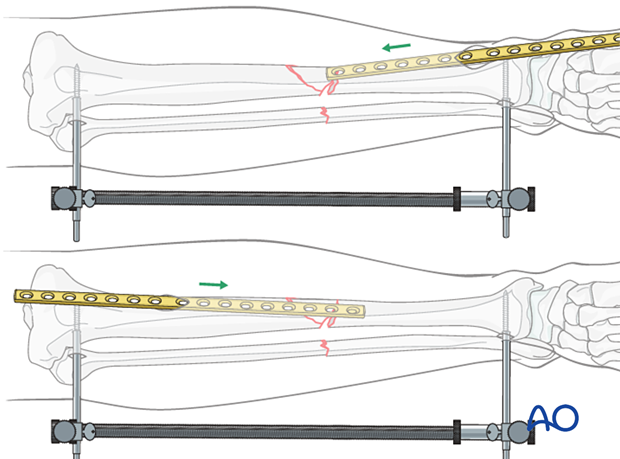
The plate can be inserted either through the proximal (antegrade) or distal incision (in a retrograde manner).
The tunnel for the plate should be prepared at the time of making the approach either with a specialized tunneling tool, or with blunt instruments.
Insertion of first screw
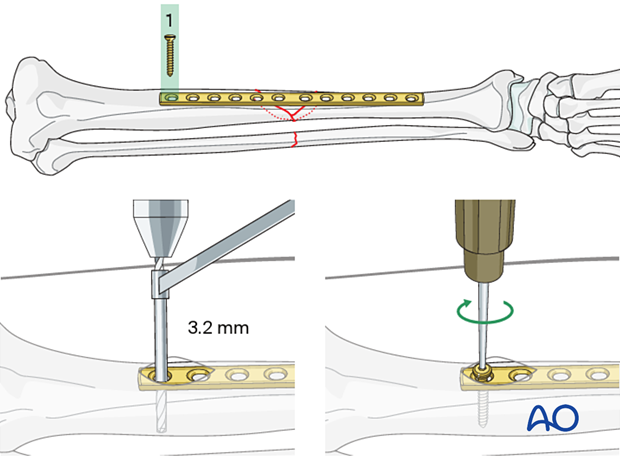
Fixation begins with one end of the plate and then progresses to the other end.
Each end of the plate must be placed in the center of the bone.
If a 4.5 mm cortical screw is used, drill with a 3.2 mm drill bit and neutral drill guide through the plate hole. Measure for screw length and insert the first screw, but do not completely tighten it.
Insertion of the second (distal) screw
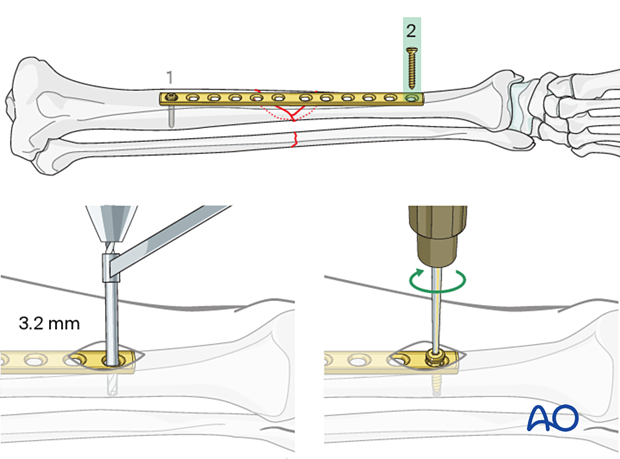
At this point, length, rotation, and coronal alignment should be checked and, if necessary, corrected.
Insert the second screw in the same fashion as described for the first screw.
Correcting sagittal displacement
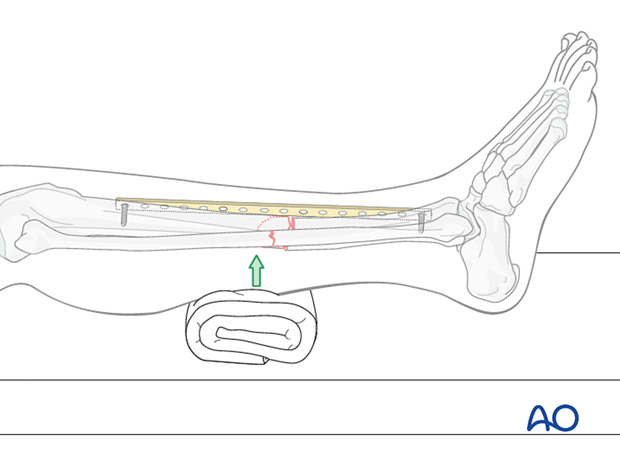
Some sagittal displacement can be corrected after the second screw has been inserted by placing a rolled towel under the fracture.
If image intensification is available, check the completed reduction before inserting further screws.
Insertion of the remaining screws
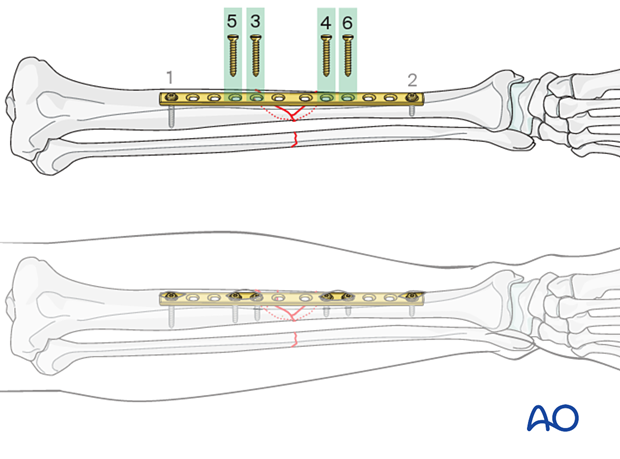
Alternating from one main fragment to the other, insert the remaining screws.
For these screws, additional small incisions over the plate are necessary.
Place two screws as close to the fracture zone as practicable in each main fragment. A minimum of three screws on each side should be used.
6. Aftercare
Perioperative antibiotics may be discontinued before 24 hours.
Attention is given to:
- Pain control
- Mobilization without early weight bearing
- Leg elevation in the presence of swelling
- Thromboembolic prophylaxis
- Early recognition of complications
Soft-tissue protection
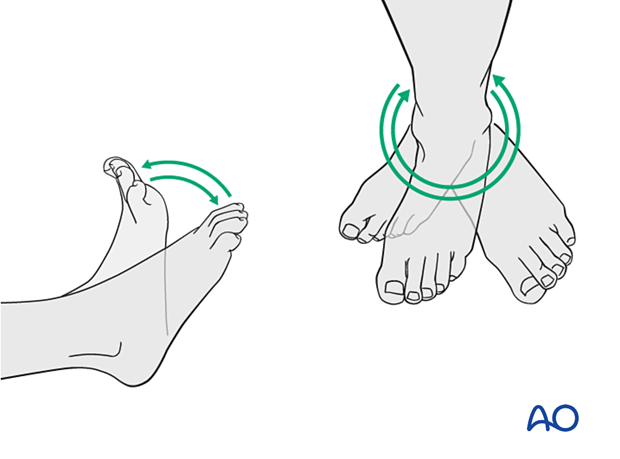
A brief period of splintage may be beneficial for protection of the soft tissues but should last no longer than 1–2 weeks. Thereafter, mobilization of the ankle and subtalar joints should be encouraged.
Mobilization
Active, active assisted, and passive motion of all joints (hip, knee, ankle, toes) may begin as soon as the patient is comfortable. Attempt to preserve passive dorsiflexion range of motion.
Weight bearing
For fractures treated with plating techniques, limited weight bearing (15 kg maximum), with crutches, may begin as tolerated, but full weight bearing should be avoided until fracture healing is more advanced (8–12 weeks).
For fractures treated with intramedullary nailing, weight bearing as tolerated, with crutches, may begin immediately.
Follow-up
Follow-up is recommended after 2, 6, and 12 weeks and every 6–12 weeks thereafter until radiographic healing and function are established. Weight bearing can be progressed after 6–8 weeks when x-rays have indicated that the fracture has shown signs of progressive healing.
Implant removal
Implant removal may be necessary in cases of soft-tissue irritation caused by the implants. The best time for implant removal is after complete bone remodeling, usually at least 12 months after surgery. This is to reduce the risk of refracture.


