

MIO - Compression plating
1. Principles
Indications
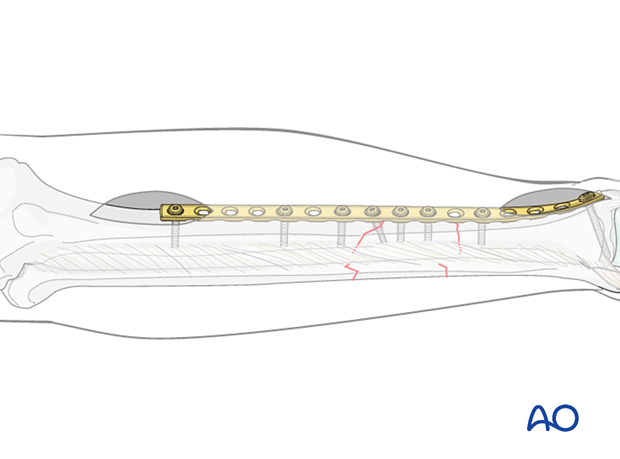
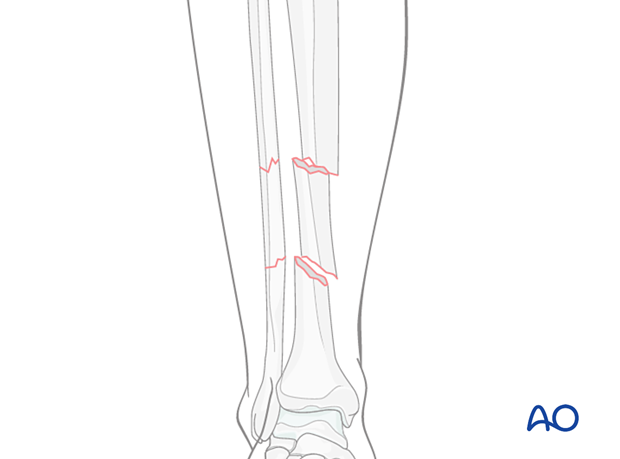
Minimally invasive osteosynthesis (MIO) compression plating should only be used for select intact segmental fractures. It is best suited for the following instances:
- Fractures with a single intermediate segment
- Minimally displaced fractures with an intermediate segment with one or more wedge fragments
Experience in minimally invasive techniques is necessary. If the operating surgeon is inexperienced, open reduction should be considered.
We illustrate one solution, but the treating surgeon must select the most appropriate approach based on a wide range of relevant factors, including fracture features, available resources, and surgeon experience.
General considerations
Tibial shaft fractures near the knee or ankle may require plate fixation instead of intramedullary (IM) nails. MIO techniques are advantageous because they preserve the biology at the fracture site. By limiting skin incisions and surgical dissection, using indirect reduction techniques and basic plating concepts, adequate fixation and alignment can be obtained without significant damage to the bone or soft-tissue envelope.
With a minimally invasive plating technique, each fracture is dealt with separately in a stepwise manner. If there is fragmentation, the fracture site will require a bridging technique. Simple short oblique or transverse fractures should be fixed with interfragmentary compression to obtain absolute stability.
Preoperative planning
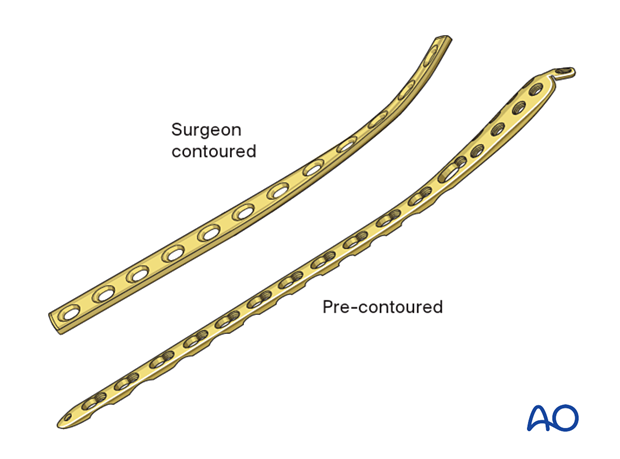
Preoperative planning is of utmost importance and should include all steps of the procedure (including appropriate approaches, reduction techniques, instruments, and implants). Anatomically shaped plates are helpful but not necessary for this technique. Plate bending devices may be used to shape a straight plate to fit the bony surface.
Intraoperative imaging
With limited windows through the skin and no direct visualization of the fragments, image intensifier fluoroscopy is a key surgical tool for MIO. The image intensifier field of view should be as large as possible to allow assessment of alignment. The position of the C-arm is critical in order to achieve orthogonal views during surgery. This should be tested before surgery.
2. Patient preparation and approaches
Patient preparation
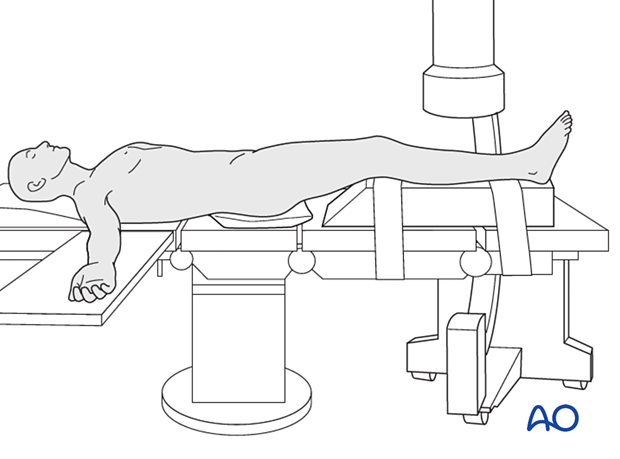
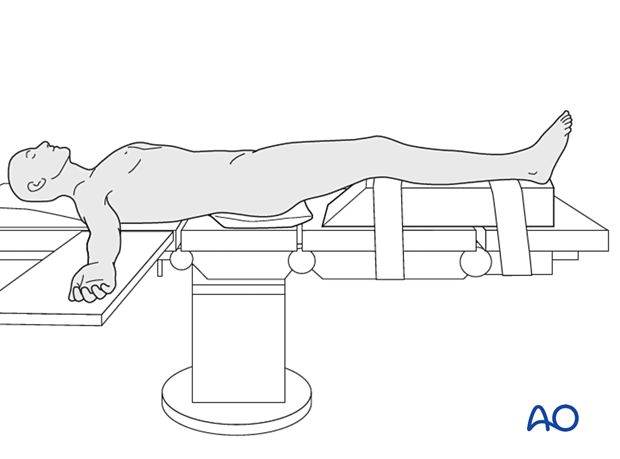
The patient is placed in a supine position on a radiolucent table or a standard operating table with a radiolucent extension. A pad is placed underneath the buttock to prevent external rotation.
A large foam bolster or cushion is placed under the affected leg to raise it above the opposite leg so as to facilitate lateral C-arm images.
Approaches
If the soft tissues allow, a medial approach is preferred because it is easier to pass the screws percutaneously with less soft-tissue interference.
The lateral approach should be chosen if the medial soft tissues are compromised.
In certain fracture patterns, a combination of open and closed techniques may be necessary. Conversion to an open method is sometimes required when closed methods do not achieve a sufficient reduction.

3. Reduction
Reduction principle
The key to all fracture reduction is restoring axial length.
Length can be gained with:
- Manual traction
- Distractor/external fixator
- Articulated tension device (ATD)
- Push-pull screws
- Reduction forceps
Manual traction
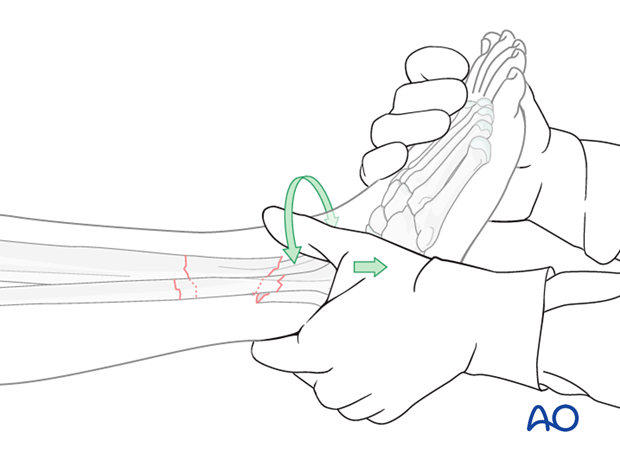
Apply longitudinal traction to the foot.
After correct length and axial alignment have been achieved, evaluate and correct the rotational deformity. One should determine the correct rotation from the uninjured extremity preoperatively.
Manual traction can be effective in fresh fractures but may be ineffective in fractures with soft-tissue contractures, significant shortening, or early fracture healing.
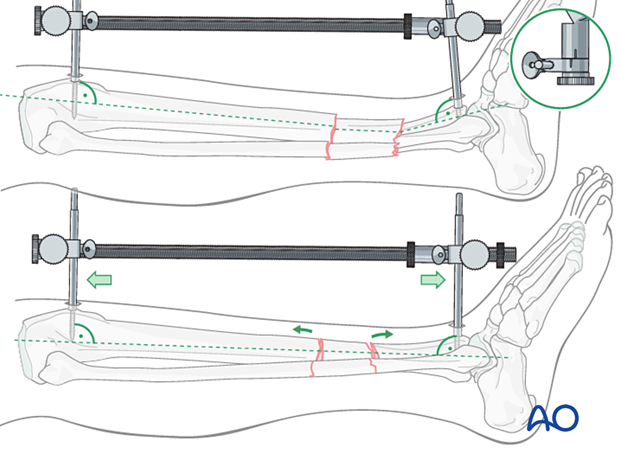
Large distractor or external fixator
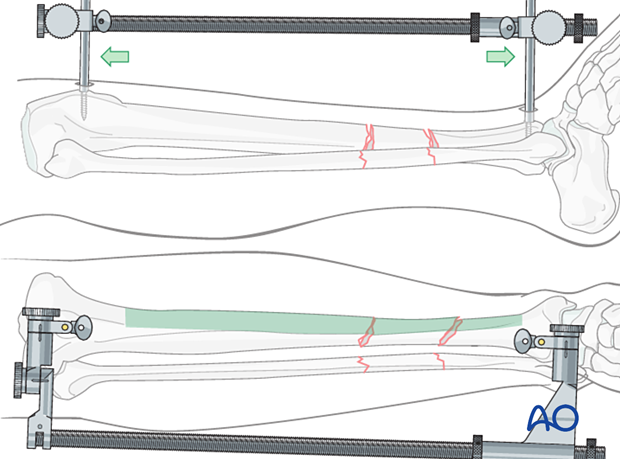
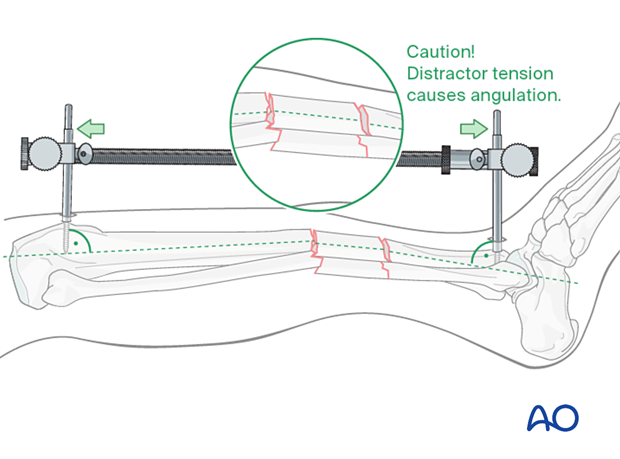
A large distractor can be used for closed reduction. Place Schanz pins in the proximal and distal fragments. Distraction is applied across these pins by turning the nut on the threaded rod.
It may be necessary to place a Schanz pin in the intermediate fragment and use it as a joystick to allow manipulation. Generally, it is easiest to reduce the least displaced of the two fractures and stabilize that fracture component.
If the plate is to be placed medially, then the distractor should be placed anteriorly.
Articulated tension device (ATD)
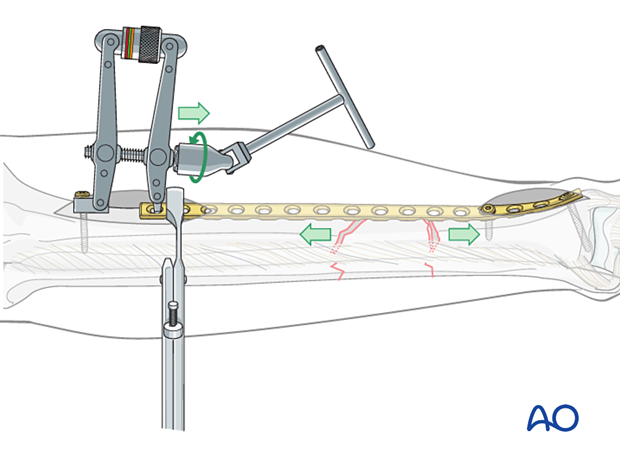
To use the articulated tension device (ATD) in distraction mode, a precontoured plate is applied to one of the main fracture fragments. A distracting force is applied with the ATD against the opposite end of the plate.
With a segmental fracture, it is necessary to reduce one fracture anatomically, stabilize it, and then repeat for the second fracture.
The first step is to distract both fracture sites, as shown in the illustration.
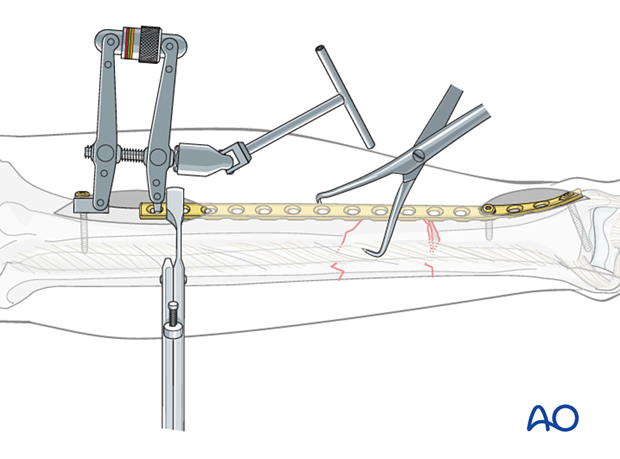
In this illustration, the proximal, short oblique fracture has been anatomically reduced and provisionally fixed with percutaneous pointed reduction forceps.
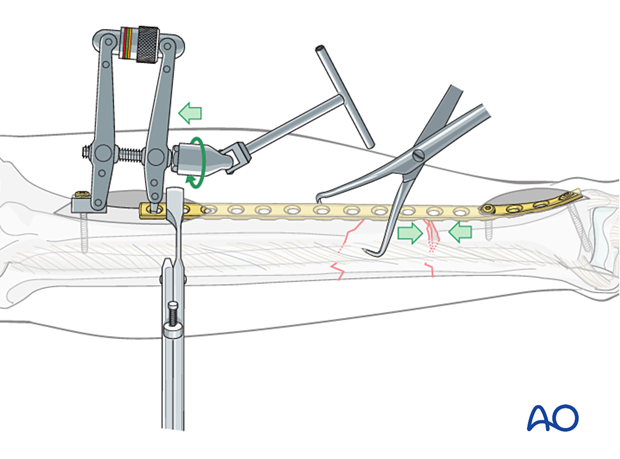
With the proximal fracture provisionally fixed with the pointed reduction forceps, the transverse fracture is reduced and then compressed using the ATD.
Push-pull screw
A precontoured plate is applied to one of the main fragments. A bicortical push-pull screw is then placed proximal to the end of the plate, and a laminar spreader is used to apply a distraction force through the plate. This distracts the fracture sites so that they can be reduced.
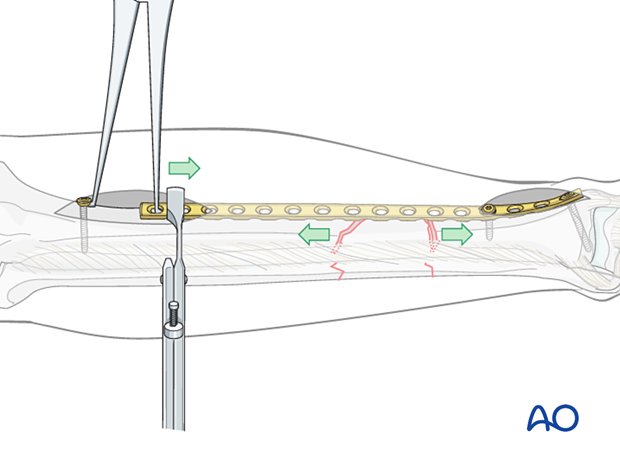
Then, with the length restored, the short oblique fracture can be reduced anatomically with the pointed reduction forceps.
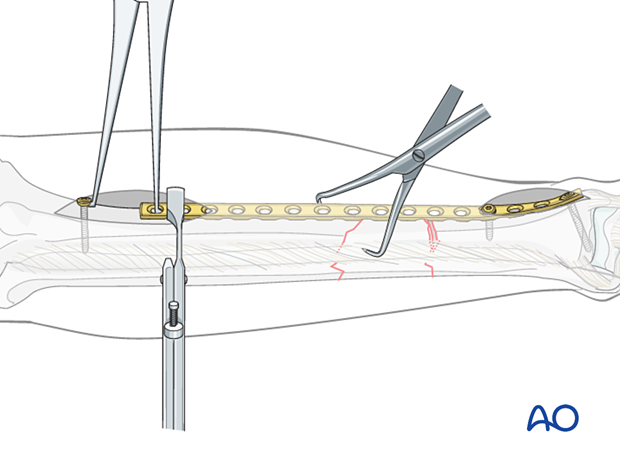
With the proximal fracture reduced with the reduction forceps, the transverse fracture is reduced and compressed using a Verbrugge clamp between the proximal hole in the plate and the push-pull screw.
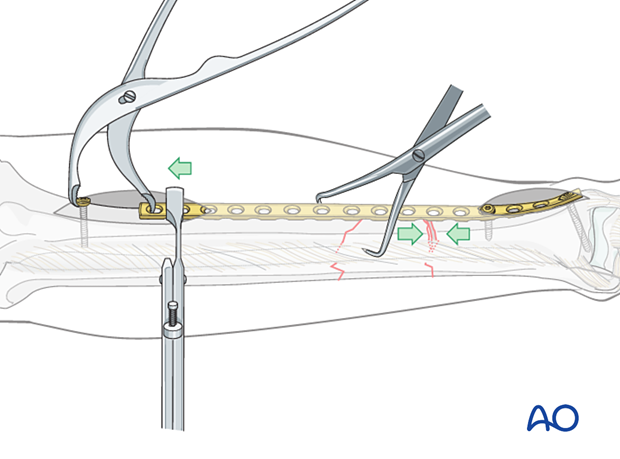
Pointed reduction forceps
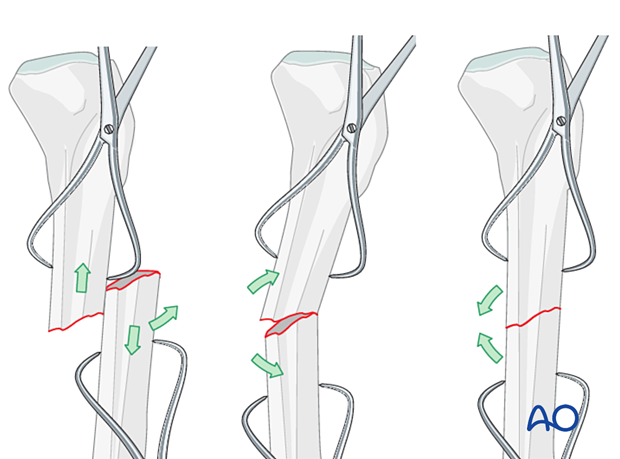
Final reduction may be possible with percutaneously applied pointed reduction forceps. The presence of a free shaft segment may prevent successful reduction. The application of another clamp or the insertion of a joystick into the free segment can aid in reduction.
Placement of the reduction forceps is key. Each point must be placed in anticipation of where it will be with the fracture reduced once length is restored. The forceps should be applied with the tines perpendicular to the fracture plane, as illustrated.
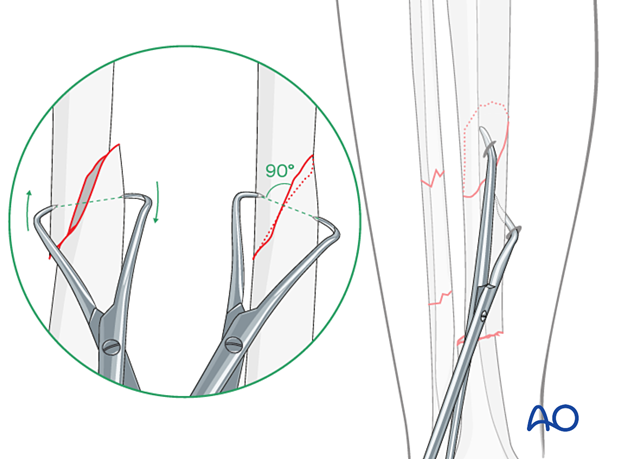
Pointed reduction forceps may also be used to grasp and manipulate fracture fragments, as shown here. These clamps are not effective for compressing the fracture surfaces of transverse or short oblique fractures.
4. Plate selection and preparation
Choice of plate
Plate length is based upon symmetry above and below the fracture zone. For most intact segmental fractures, the fracture zone includes both fracture sites. At least 3–4 screw holes on either side of the fracture zone are necessary. Another guideline, when fracture location permits, is that the plate should be roughly three times the length of the fracture zone.
Many segmental fractures can be fixed with standard plates after appropriate contouring.
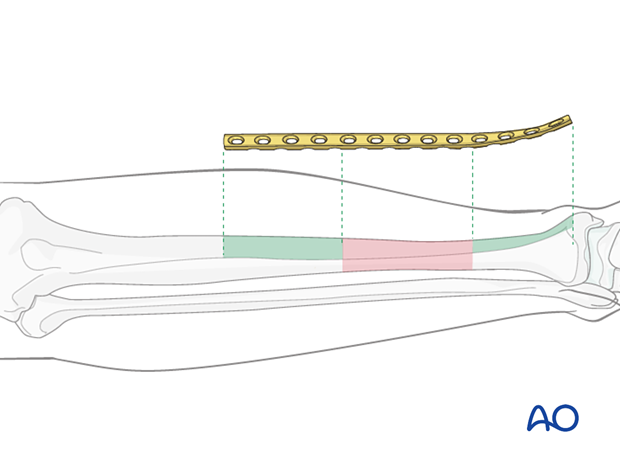
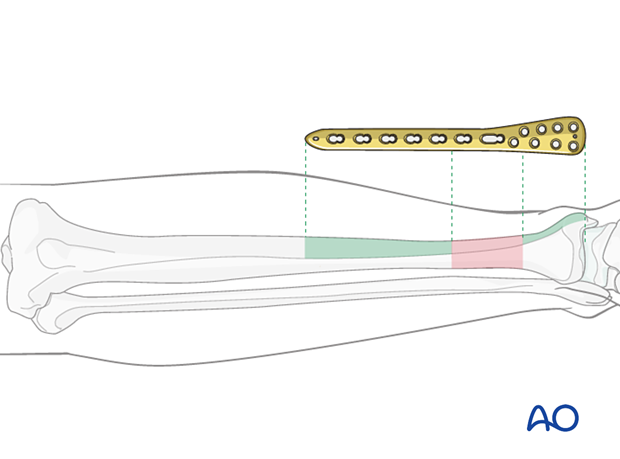
When the fracture zone is very distal or proximal, there may not be enough room for symmetric plate length in the segment nearest the articular surface. In this situation, a plate with multiple hole options in the metaphysis is chosen to improve fixation in the short periarticular segment.
A locking plate may be indicated if the bone quality is poor or if the fracture extends into softer metaphyseal bone.
Traditionally a 4.5 mm plate has been advised for the tibial shaft. Advantages include increased plate thickness and larger screw size for added strength. These plates are more difficult to contour and may be too prominent.
A 3.5 mm plate offers improved contourability and multiple screw options in metaphyseal (end-segment) zones. As these plates are thinner, they are less stiff than the large fragment plates.
Another consideration is the choice between an anatomically precontoured plate or one which the surgeon contours. For plates that need to be contoured, the following steps must be employed.
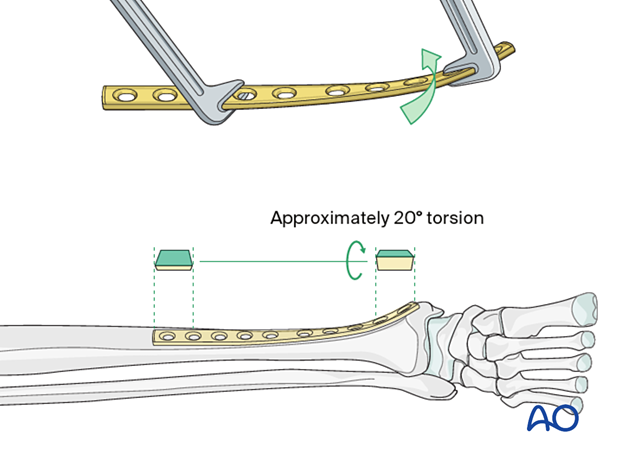
Twisting the plate
The anteromedial surface of the tibial shaft twists internally approximately 20° as it approaches the medial malleolus.
The first step of plate contouring is to twist the plate so it matches the tibial surface upon which it will lie.
If the plate is bent before it is twisted, the process of twisting will alter the bend that has been created.
Matching the curvature
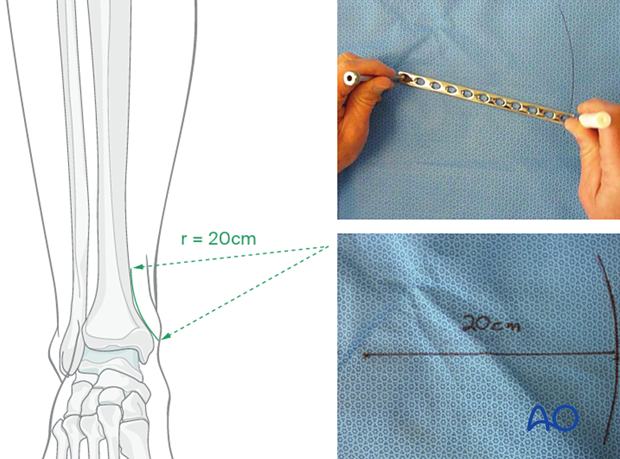
Depending upon the plate location, more or less bending of the plate will be required to match the contour of the intact (or reduced) bone. Much of the medial tibial shaft is quite straight, so little bending is required, however, the distal medial surface has a significant concavity, with a typical radius of curvature of 20 cm, as illustrated.
A 20 cm radius can be drawn on a sterile drape and used as a template for plates to be used in this location.
Bending the plate
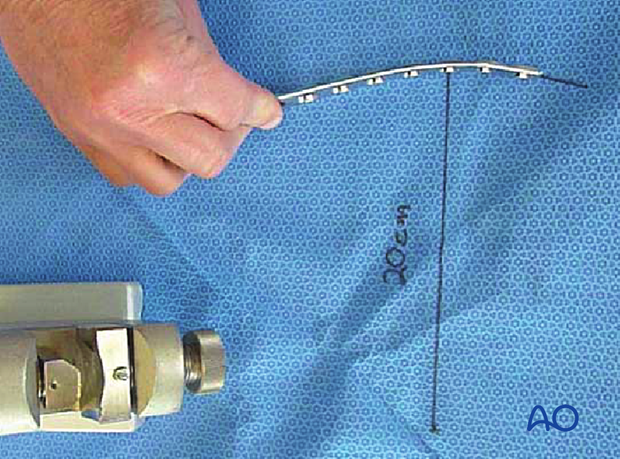
The plate can be bent with bending irons alone, but bending with a bending press is preferable because it gives more control.
In either case, the bending is done in small steps to produce a smooth contour. Contouring only takes place over the distal 10–12 cm of the plate. When finished, the plate should match the 20 cm radius of curvature.
5. Fixation
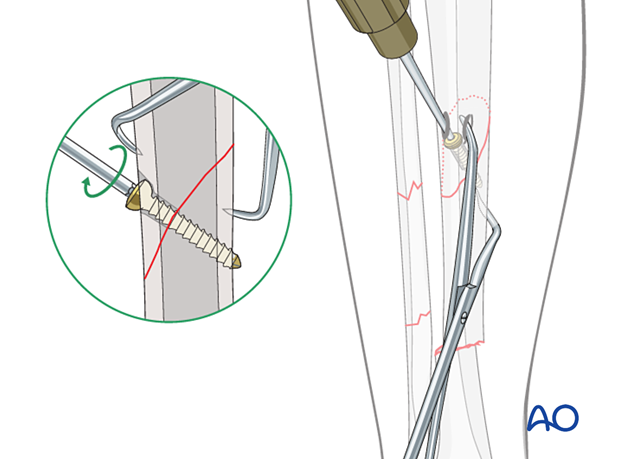
If an oblique fracture is long enough, a percutaneous lag screw can be used to compress the final reduction. This can be done outside of the plate or through the plate.
Note that in this example, the proximal fracture has been reduced anatomically and fixed with a lag screw. The distal fracture will now be reduced and fixed with the plate in compression mode. This plate also neutralizes the proximal fracture so as to protect the lag screw.
6. Plate application
Plate insertion
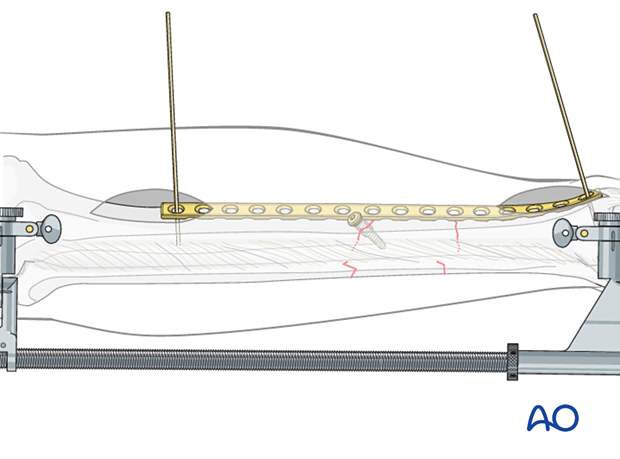
An incision is made over the distal tibia and the plate is slid under the subcutaneous tissues.
If a locking plate or an anatomically contoured plate is used, the specifically designed end of the plate will facilitate this passage. With a conventional limited contact dynamic compression (LCDC) plate, it may be necessary to use a periosteal elevator to create a subcutaneous tunnel. If available, a subcutaneous tunneling device could be used.

The position of the plate is adjusted on both the AP and lateral views of the tibia. At this point, the plate can be provisionally held with K-wires.
Initial screw placement
Through an image-directed stab wound, place the first screw according to antiglide principles (closing any gap between bone and plate to resist axial displacement) to improve axial alignment.
Reduction will only result if the correct length has been achieved first. Check both AP and lateral views of the tibia.
The initial screw must engage both cortices so it can securely apply the plate to bone. As the plate is typically not apposed to bone when it is applied, the first screw may be found to be too long once the plate has appropriate contact. It should be exchanged later, after additional screws are placed.
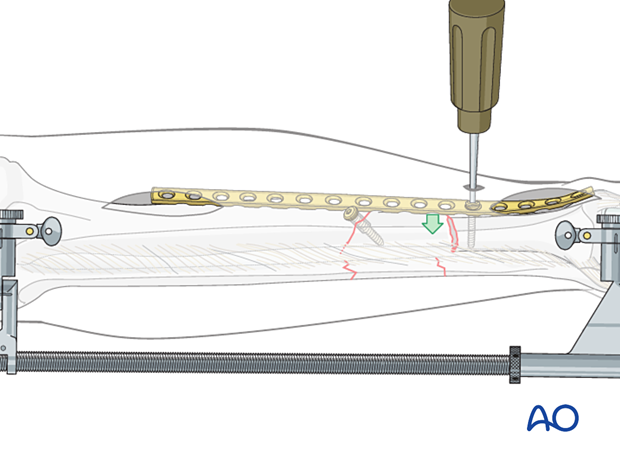
Compression screw
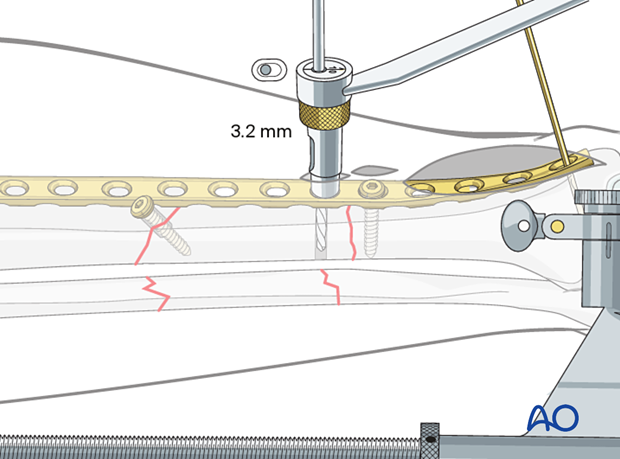
Fracture compression is applied after reduction. This may be done with the articulated tension device or a push-pull screw and Verbrugge clamp.
Additional compression can be applied to a well-reduced fracture using a screw in the opposite main bone fragment. This is placed eccentrically in dynamic compression (DC) plate hole with an appropriate guide.
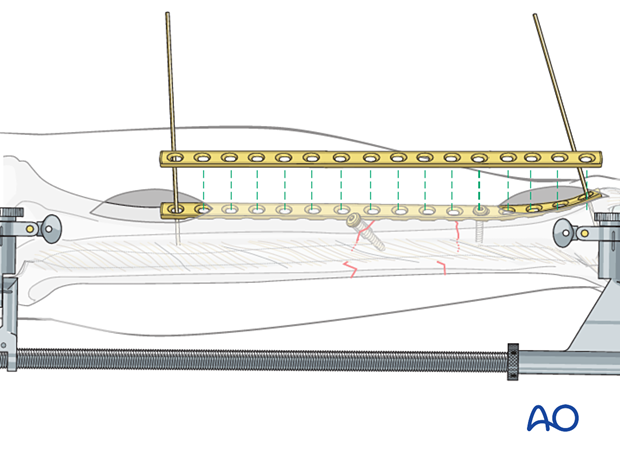
Interfragmentary lag screw
For sufficiently oblique fractures, absolute stability is best achieved by compressing the fracture plane with an interfragmentary lag screw placed perpendicular to the fracture.
Transverse fractures must rely upon tension-loading by an appropriately contoured compression plate.
- Basic technique: Cortical lag screw insertion
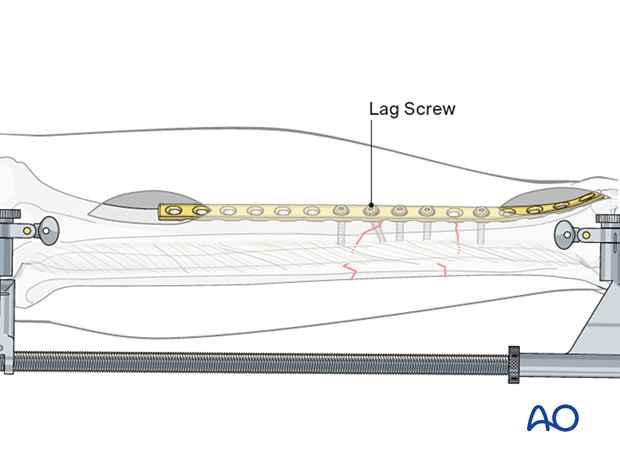
Insertion of remaining screws
Place the remaining screws at the distal and proximal ends of the plate. Exchange any screws that are too long for those of the proper length.
Alternative fixation methods
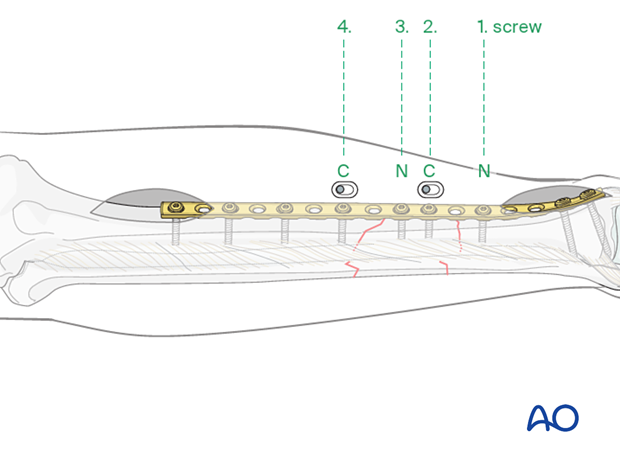
Multiple techniques are possible depending upon fracture location and obliquity. This illustration shows the use of dynamic compression (eccentric screw placement in dynamic compression plate holes) to stabilize both fractures.
7. Aftercare
Perioperative antibiotics may be discontinued before 24 hours.
Attention is given to:
- Pain control
- Mobilization without early weight bearing
- Leg elevation in the presence of swelling
- Thromboembolic prophylaxis
- Early recognition of complications
Soft-tissue protection
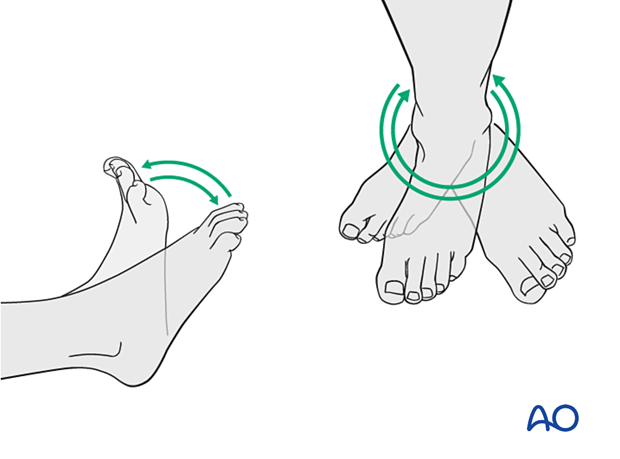
A brief period of splintage may be beneficial for protection of the soft tissues but should last no longer than 1–2 weeks. Thereafter, mobilization of the ankle and subtalar joints should be encouraged.
Mobilization
Active, active assisted, and passive motion of all joints (hip, knee, ankle, toes) may begin as soon as the patient is comfortable. Attempt to preserve passive dorsiflexion range of motion.
Weight bearing
For fractures treated with plating techniques, limited weight bearing (15 kg maximum), with crutches, may begin as tolerated, but full weight bearing should be avoided until fracture healing is more advanced (8–12 weeks).
For fractures treated with intramedullary nailing, weight bearing as tolerated, with crutches, may begin immediately.
Follow-up
Follow-up is recommended after 2, 6, and 12 weeks and every 6–12 weeks thereafter until radiographic healing and function are established. Weight bearing can be progressed after 6–8 weeks when x-rays have indicated that the fracture has shown signs of progressive healing.
Implant removal
Implant removal may be necessary in cases of soft-tissue irritation caused by the implants. The best time for implant removal is after complete bone remodeling, usually at least 12 months after surgery. This is to reduce the risk of refracture.


