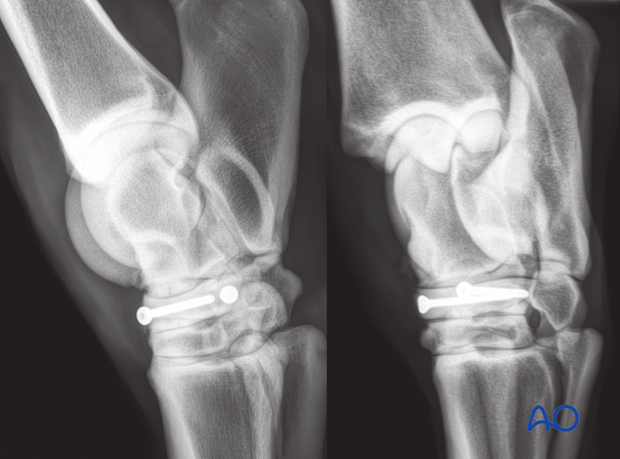
Screw fixation
1. Preparation and approach
This procedure is performed with the patient placed in lateral recumbency and through stab incisions.
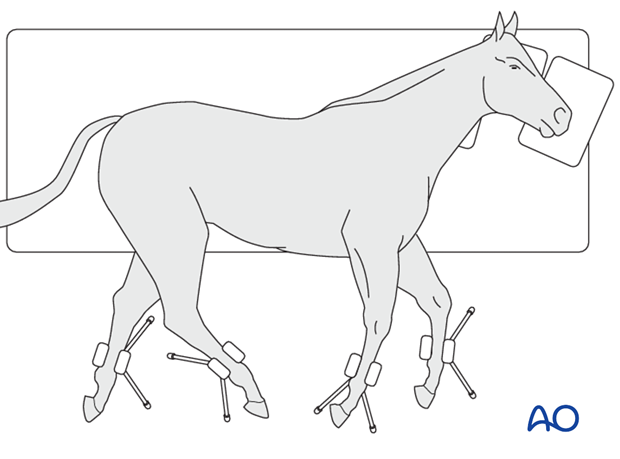
2. Surgical technique
Planning the screw position
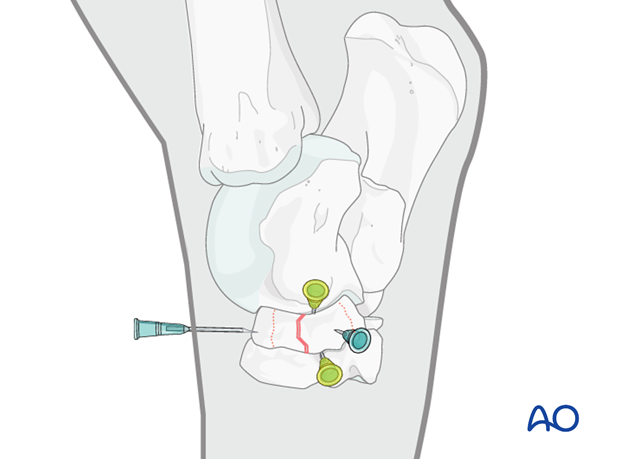
The optimal screw position is chosen based on the fracture configuration seen on CT images.
Screw position is determined with the help of needles. One needle is placed into the proximal intertarsal joint, one into the distal intertarsal joint and two at the intended screw positions, according to fracture configuration.
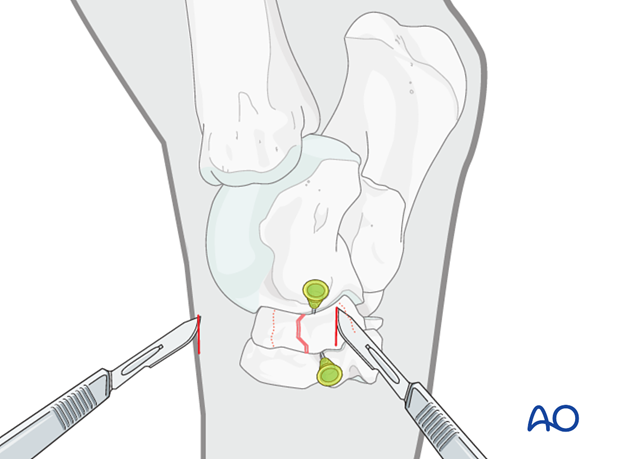
Stab incision
Two stab incisions are placed over the planned screw positions.
Screw insertion
Screw insertion at the preplanned angles necessitates to drill blind holes. Therefore the steps for screw insertion in lag fashion have to be executed with the utmost care to avoid stripping of the tapped threads, insertion of too long a screw, preventing interfragmentary compression and inadvertent contact of the two screws.
Two 40 - 60 mm 4.5 cortex screws are inserted using routine lag technique according to fracture configuration.
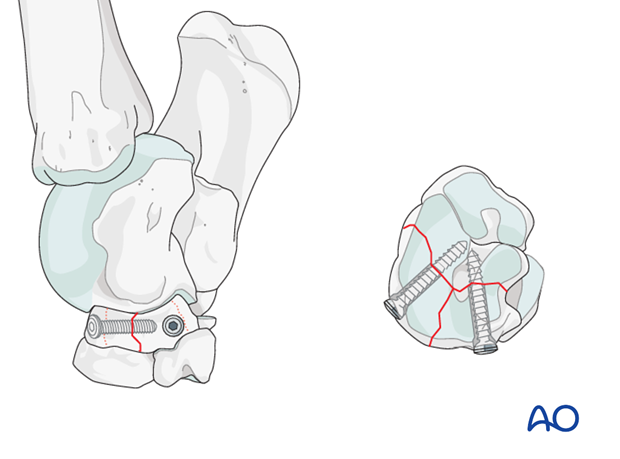
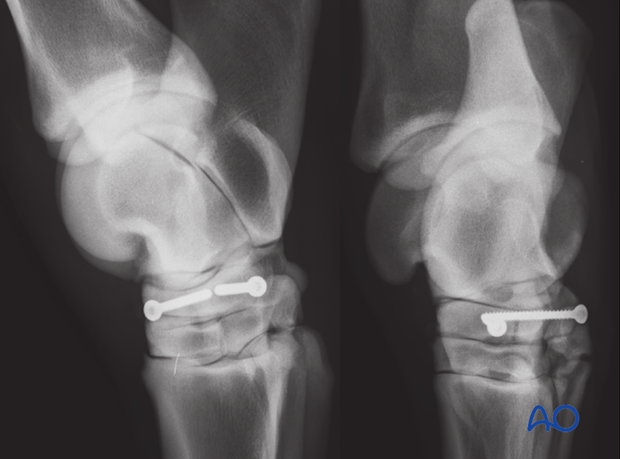
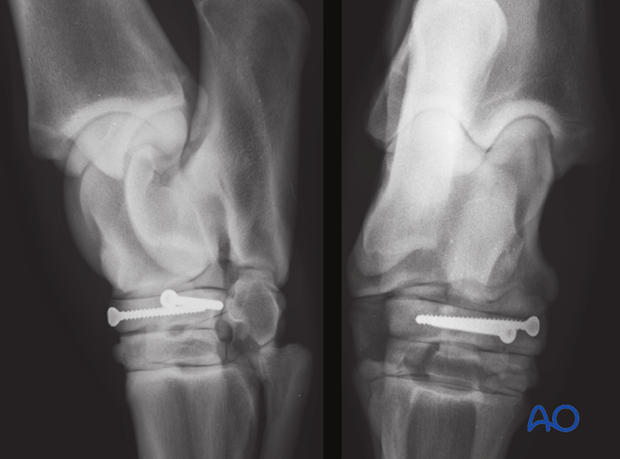
Correct screw placement is confirmed using the C-arm before the stab incisions are closed in two layers.
3. Aftertreatment
Recovery
A support bandage that includes the entire tarsal region is applied and the horse is recovered from anaesthesia with manual assistance.
Aftercare
The limb is bandaged for 15 days. The horse is confined to a box stall for 2 months, after which time it is put on a small paddock or another 2 months. The sutures are removed 10 days postoperatively.
Implant removal
If the lameness persists after surgery, it may be necessary to remove the screw via a medial stab incision. It is believed that postsurgical pain is caused by the rigid implant in a less rigid bone. This is supported by the observation that after implant removal horses have a higher rate of return to athletic activity.