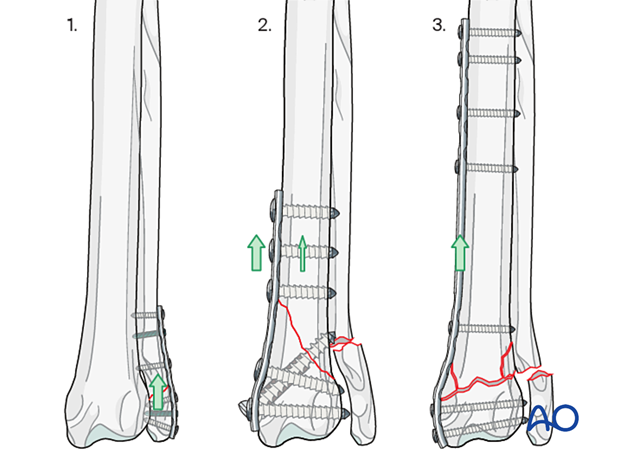
Plate preparation
1. Nonlocking plates
Nonlocking plates must be anatomically contoured to the surface of the bone.
If a dynamic compression plate or limited contact dynamic compression plate is used, it must be contoured accurately to the bone's corresponding surface.
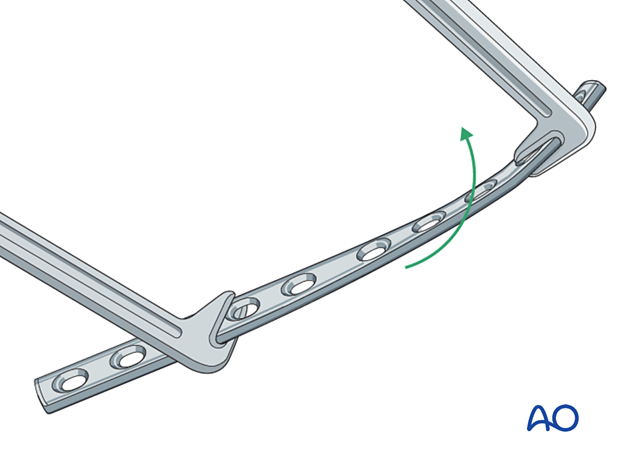
2. Locking plates
Locking plates may need some contouring; they should not be more than 2 mm away from the surface of the bone.
The screws inserted should not be too long to avoid interference with the ulna.
Pearl: The screw length should be measured on the x-ray and with a depth gauge in surgery to ensure the screw is not engaging the ulna. Fluoroscopy can also be used to ensure proper screw length.
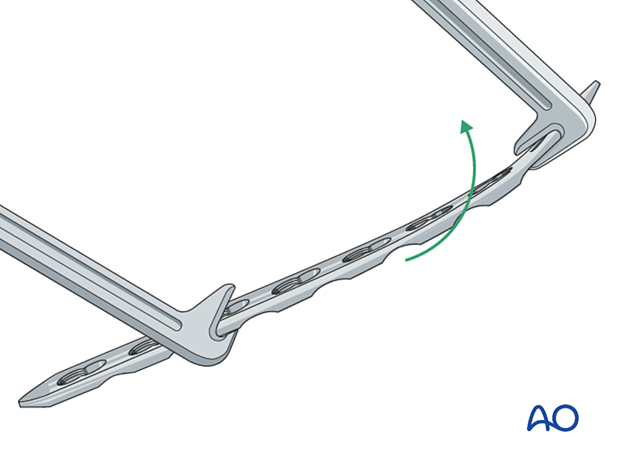
3. Compression plates
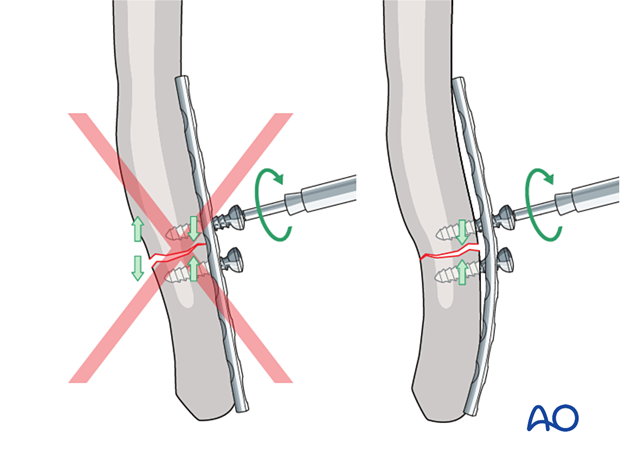
Compression plates must be prestressed to produce a 1–2 mm gap between the plate and the bone over the fracture sites. Overbending the plate at the fracture site ensures even compression across the fracture line when the screws are tightened.
4. Relation between plate function and load bearing
- When using a compression plate, load is shared between the implant and the bone column. The main load is through the bone column.
- When using a neutralization plate, the load is shared between the implants and the bone column.
- When using a bridging plate, the load is entirely carried by the implant.