

Nonoperative treatment (casting)
1. Indications
Undisplaced or minimally displaced fractures
Nonoperative treatment can be recommended for undisplaced or minimally displaced fractures.
Displaced fractures
Displaced fractures that can be reduced, and that maintain acceptable alignment, can also be treated nonoperatively, ie, oblique or transverse fractures, especially if the fibula is intact.
These fractures need serial x-rays to ensure reduction is maintained.
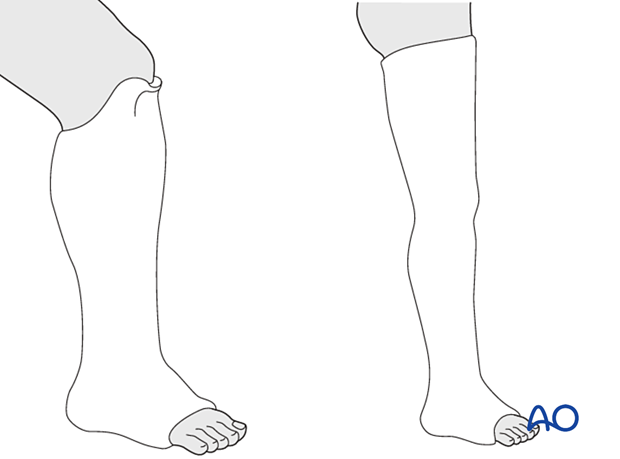
Long leg cast
Nonoperative treatment is initiated with the application of a long leg cast spanning from above the knee to below the ankle.
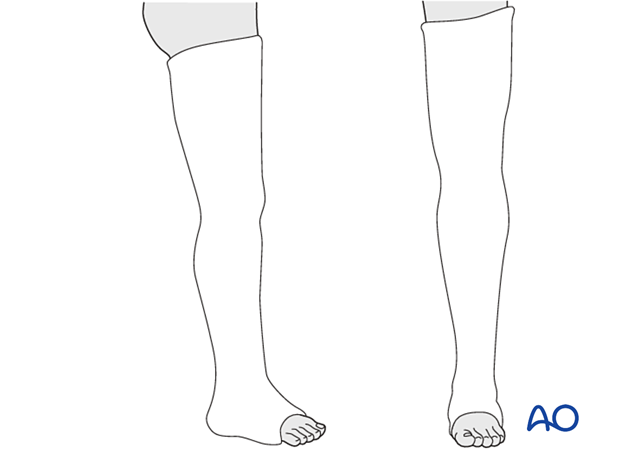
Sarmiento cast
A Sarmiento or patella tendon bearing cast (PTB) is usually applied as the last stage of treatment for tibia fractures. At 4–6 weeks post injury, the long leg cast is removed, and a Sarmiento cast is applied.
Teaching videos
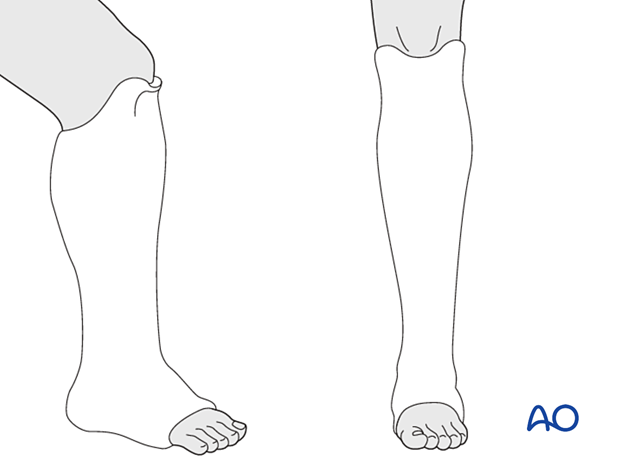
AO teaching video: Upper leg circular cast
AO teaching video: Patella tendon bearing cast (PTB)
2. Reduction techniques
Positioning
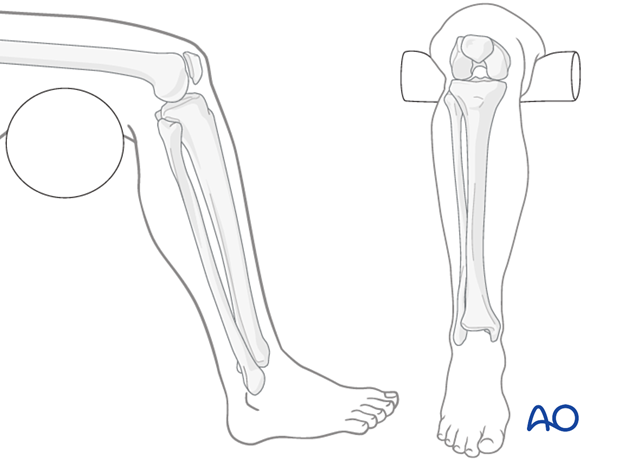
The surgeon is seated on a low chair. The patient’s knee is flexed over the end of the table; the thigh is supported with padding.
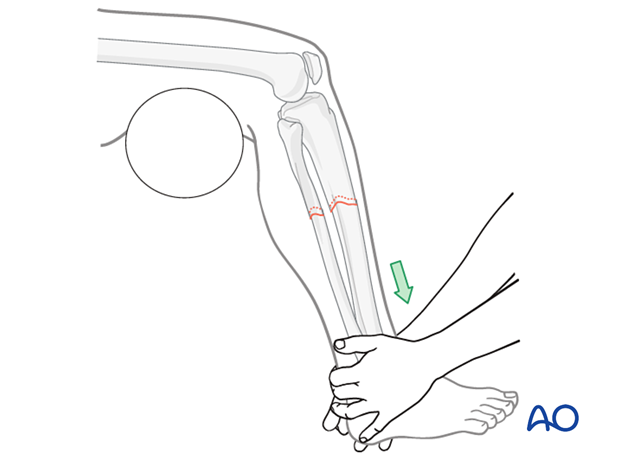
Correction of length
The illustration shows manual traction at the ankle to correct length.
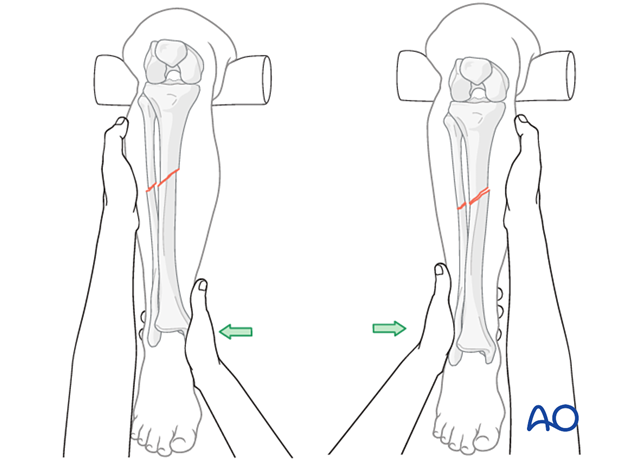
Correction of angulation
This illustration shows correction of varus or valgus deformity.
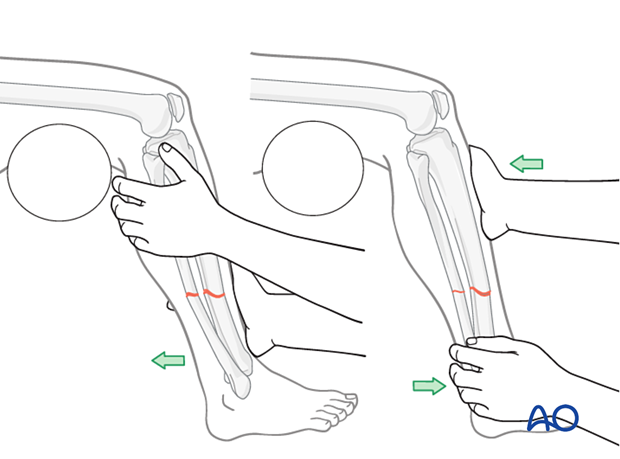
This illustration shows correction of AP angulation.
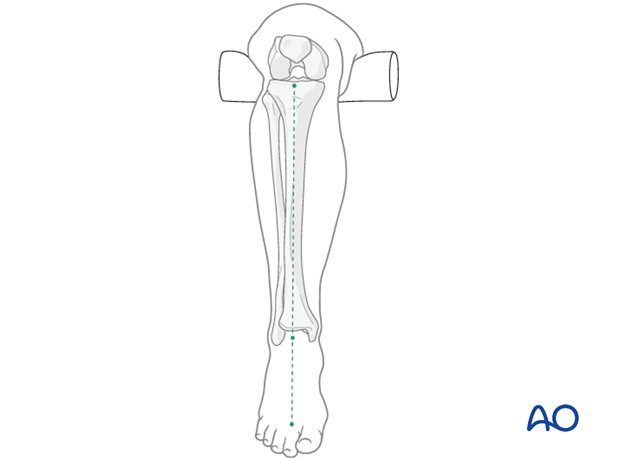
Correction of rotation
Rotation is usually corrected by palpation of the tibial crest, or with the help of an imaginary alignment of the middle of the second toe, the center of the ankle, and the tibial tubercle.
3. Application of a long leg cast
Short leg section of the cast
First apply the short leg section of the cast up to the mid patella.
Mold the plaster as it sets.
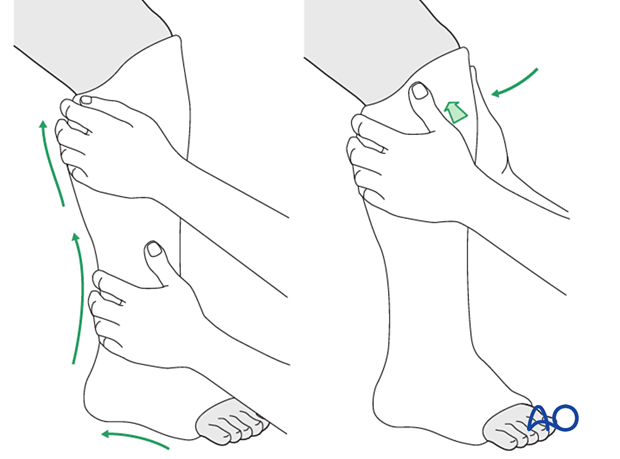
Mold in the transverse and longitudinal arches of the foot, and around the malleoli, and mold a posterior bulge for the Achilles tendon.
Smooth the cast along the entire anteromedial border of the tibia.
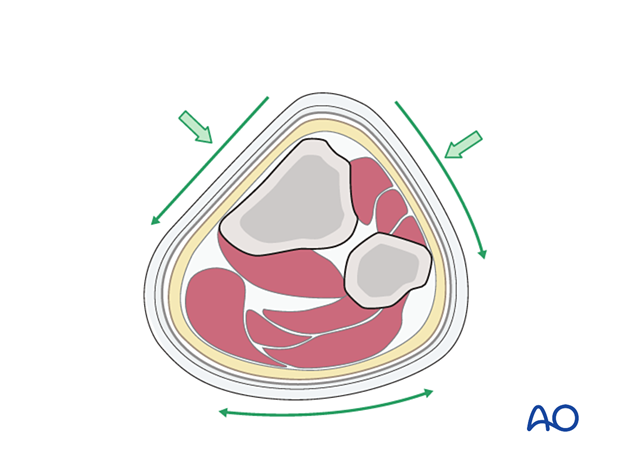
Mold the posterior side of the cast to assume a triangular shape, slightly convex at the anterolateral and medial border, flat over the posterior and anterior compartments and medial surfaces as shown in the illustration.
Care must be taken not to make the cast too tight for fear of causing compartment syndrome or skin ischemia over bony prominences. If the patient considers the cast to be too tight, it can be bivalved. If this does not help the cast should be reapplied.
Thigh portion of the cast
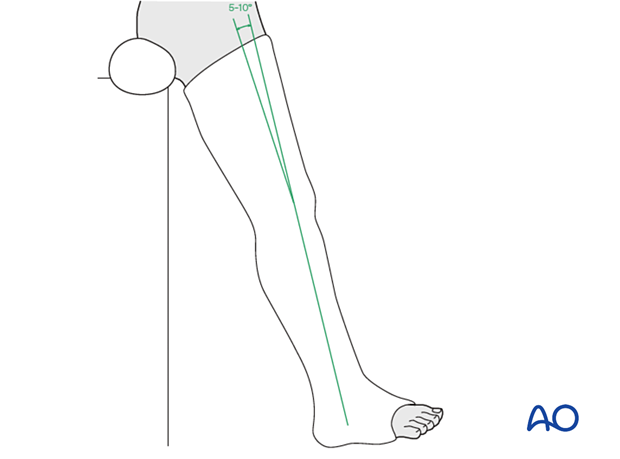
When the cast has set, the knee is extended until 5–10° short of full extension. Then the thigh portion of the cast is applied.
Proximally the cast extends to one third of the femur.
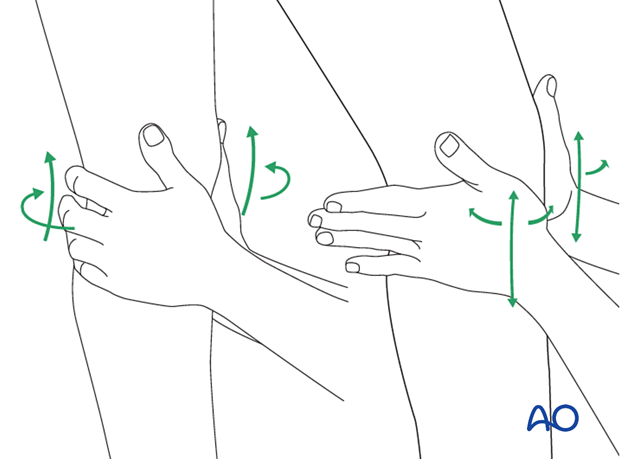
Molding of the epicondyles
Mold the cast above the medial and lateral epicondyles.
Trim the ends of the cast, reinforce the foot, and apply a walking heel if preferred.
4. Aftercare: Long leg cast
Mobilize the patient as early as possible.
For 3–7 days, until swelling subsides, check the plaster for slackness and adapt if required.
Oblique and spiral fractures are potentially unstable. Slight slipping of the fracture may be accepted, but if evidence of substantial displacement is found, internal fixation should be considered.
The long leg cast is normally applied for 6 weeks. After that it is changed to a Sarmiento or patella tendon bearing (PTB) cast.
5. Sarmiento or patella tendon bearing (PTB) cast
Principle
A Sarmiento cast or brace can be used initially in stable fractures of the distal half of the tibia.
It follows the application of a long leg cast 4–6 weeks post injury.
Application of the Sarmiento cast
The patient sits on the edge of a table. The foot is steadied.
Stockinette and soft roll are applied, and the plaster extended over the knee.
Molding of the Sarmiento cast
Before setting, the plaster is firmly molded around the patellar tendon. It is then trimmed from the upper pole of the patella around to the upper part of the calf.
Check that knee movement is free before turning down the stockinette and finishing the cast.
A rocker sole may then be applied. Weight bearing, and knee flexion are commenced. The plaster is retained until union occurs.
6. Aftercare: Sarmiento cast
Provide crutches and encourage the patient to be out of bed within 1–2 days, and to bear weight as tolerated.
Usually full, unsupported weight bearing is achieved after 3–6 weeks.
Begin isometric exercises for all muscle groups immobilized in the cast. It is important to see the patient at weekly intervals for the first 4–6 weeks when weight-bearing methods are used. Tibial fractures with an intact fibula may displace into varus. Loss of reduction must be corrected early to avoid malunion. There is also a high risk of delayed or nonunion.
If correction is not successful, operative treatment is indicated.
Change of casts
Change casts at 4–6-week intervals, depending on the stability of the fracture. Stable fracture patterns and those that gain stability early may be converted to a Sarmiento cast or fracture-brace as early as 4 weeks. Protect tibial fractures for at least 12 weeks. The average healing time is 16–24 weeks. Fracture instability after 24 weeks is considered a delayed union.
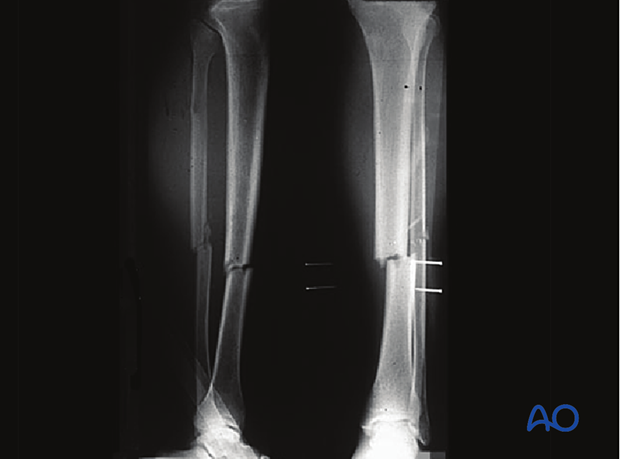
This x-ray was taken at 6 months post injury and shows partial union.
7. Case presentation: wedge cast
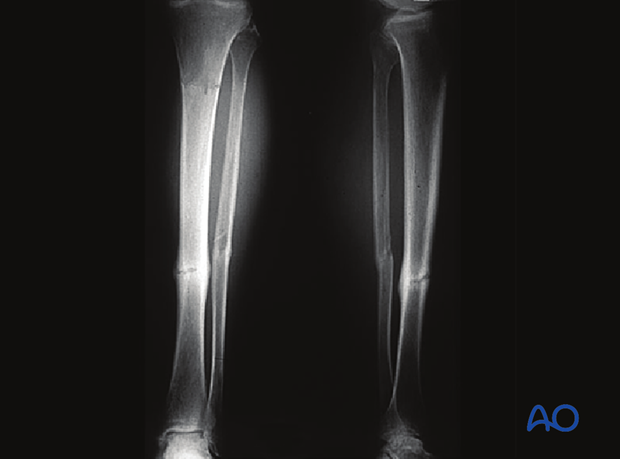
These x-rays show a simple transverse diaphyseal fracture of the tibia with an associated simple oblique fracture of the fibula. The treatment plan for this fracture is nonoperative.
Post reduction
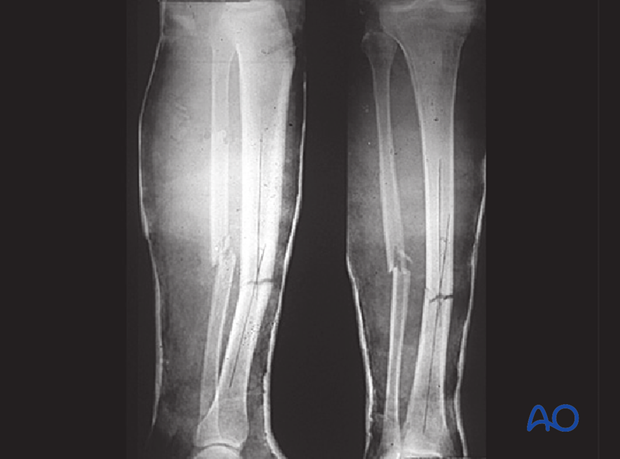
These x-rays show malreduced tibia and fibula fractures in varus and flexion.
Wedge cast
To correct the deformity, the original cast had wedges placed laterally and posteriorly. Appropriate alignment was achieved.
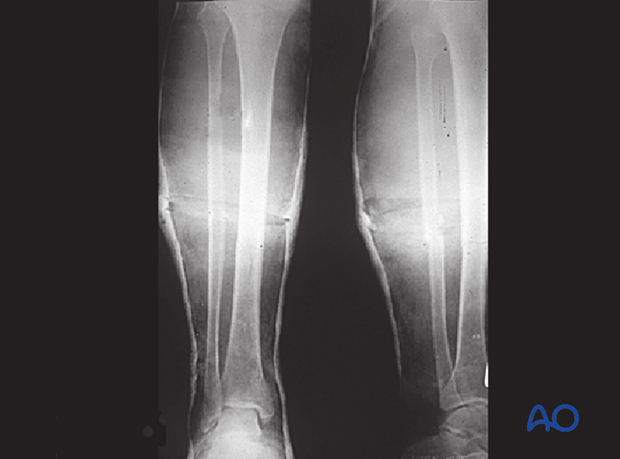
These x-rays were taken at 3 months post injury and show appropriate alignment with callus formation along the lateral and posterior cortices of the tibia.
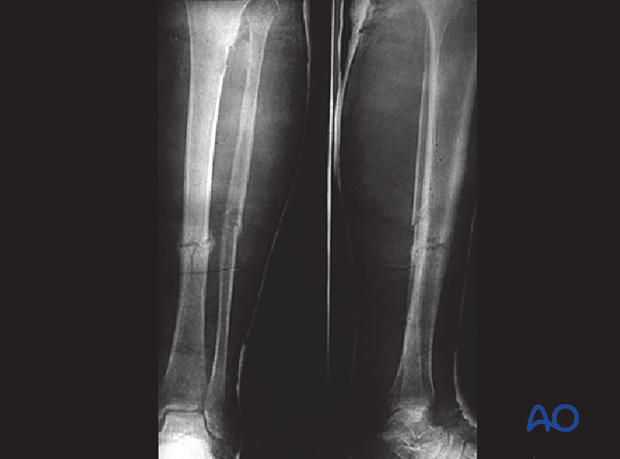
Six months post injury
These x-rays show increased bony healing, although incomplete anteriorly.
8. Aftercare
Upon cast removal, range and motion, strengthening, gait, balance, and endurance training is initiated.


