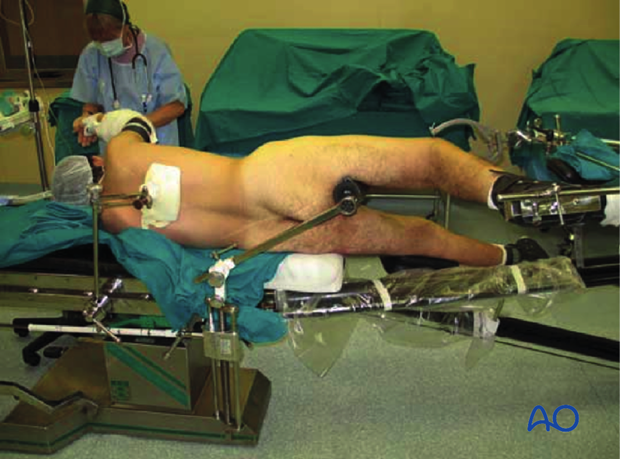
Lateral position
1. Setup and essential equipment
There will be local variation depending on resource and surgeon’s preference, but the following should be used:
- Radiolucent table
- Image intensifier with experienced radiographer
- Traction
2. Lateral position on flat-top table
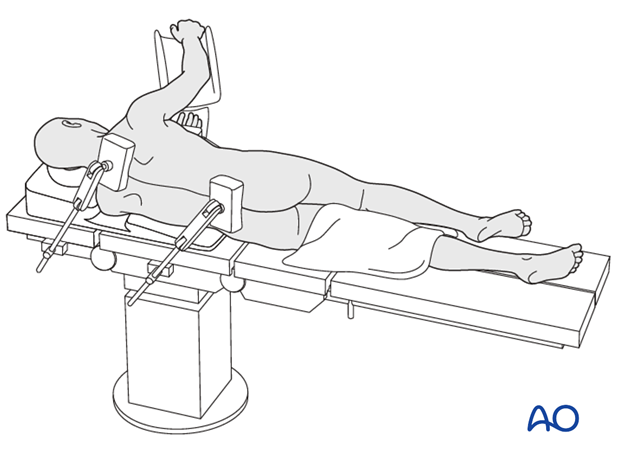
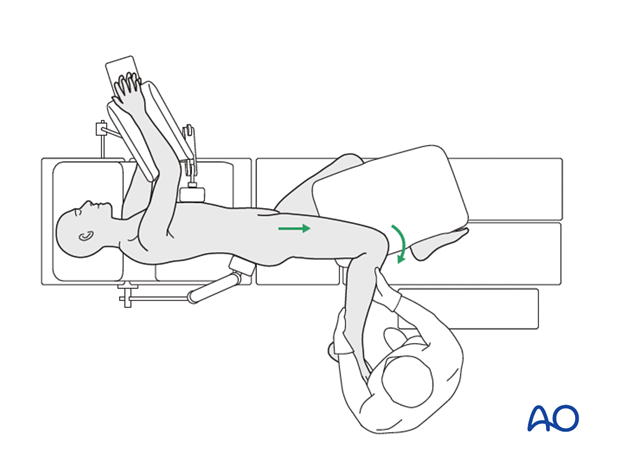
The patient is supported in the lateral decubitus position with the injured side up on a radiolucent flat-top operating table.
Place padded cushions under bony prominences to avoid excessive pressure. An alternative to the illustrated body supports is to use a radiolucent vacuum mattress to stabilize the patient.
The injured extremity is draped free to allow limb mobilization throughout the operation.
3. Image intensification
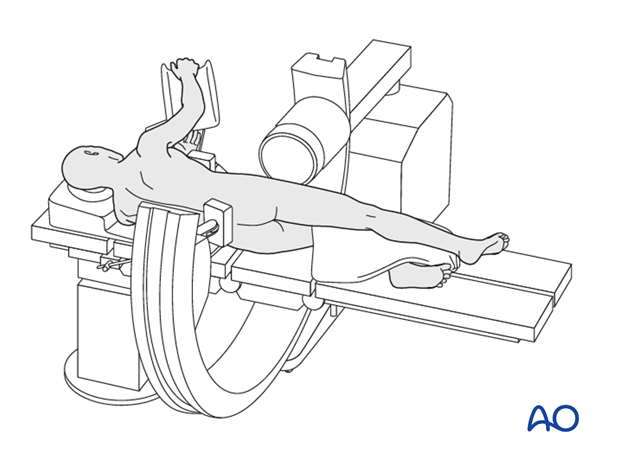
Before draping, make sure the involved acetabulum is well visible under fluoroscopy in AP, iliac and obturator oblique views.
4. Alternative: fracture table
The patient is supported in the lateral decubitus position on a specially designed fracture table.
An appropriate fracture table allows complete mobility of the hip, as well as distal traction through an ipsilateral distal femoral distraction pin and laterally directed pressure with an adjustable post supporting the proximal part of the thigh. The ipsilateral knee must be flexed at least 45° to relax the sciatic nerve.
Firmly support the patient’s chest with padded posts. The perineal post, between the thighs, helps stabilize the pelvis, with countertraction, if necessary.
The table spars may be adjusted intraoperatively to assist fracture reduction, by changing the position of the hip.
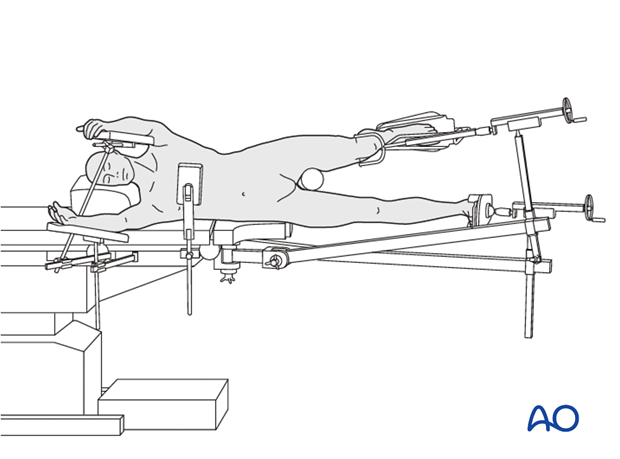
Note that the “perineal post” is actually supporting the ipsilateral thigh rather than exerting perineal pressure.