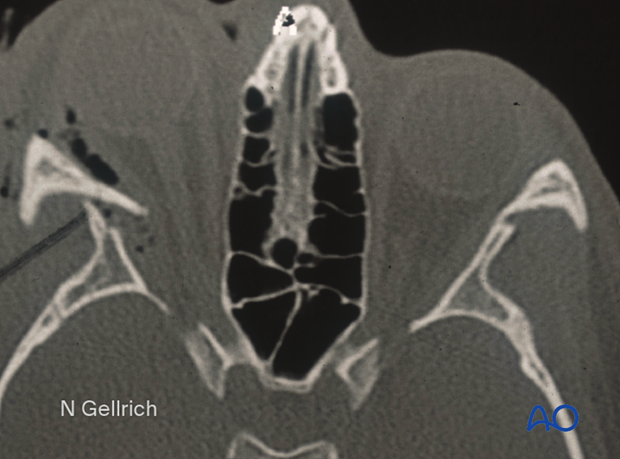
Isolated lateral orbital wall fracture
Definition
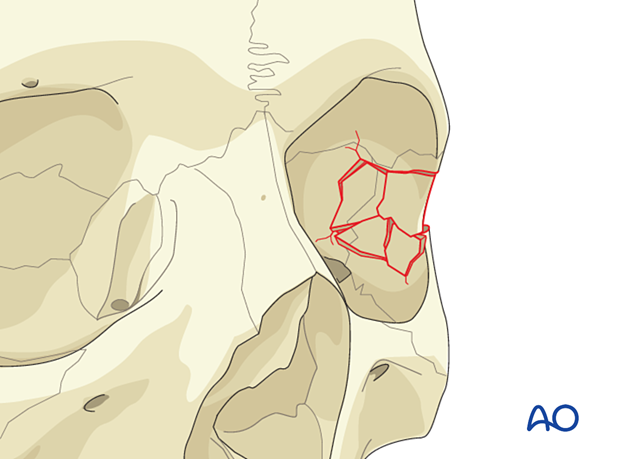
Isolated orbital wall fractures may involve any aspect of the orbital wall. While lateral orbital wall fractures may be isolated, they are commonly a part of every significant zygoma fracture. The lateral orbital fracture which occurs with zygoma fractures is described in the zygoma section.
Clinical diagnosis is based on a meticulous examination of the eye and adnexa, including the patient's vision and palpation of the orbital wall. Since the advent of CT imaging, the surgeon can better define fractures, the degree of fracture displacement, and the necessity for fracture reduction. 2D CTs should be obtained in the axial coronal planes and sagittal views such as those obtained in the longitudinal axis of the optic nerve.
The complexity of an orbital fracture is defined by the combination of its anterior-posterior and mediolateral extensions. This complexity is not visible on plain films. Therefore, proper diagnosis and treatment should be based on voxel-based datasets (CT, cone beam).
Intra-/periorbital air is a common feature of an orbital wall fracture, which appears clinically as emphysema (independent of whether the injury was penetrating or nonpenetrating).
The most widely available technology is CT scanning, which has the advantage of combined hard- and soft-tissue visualization. Cone beam technology is becoming increasingly popular, although only hard tissues can be reliably assessed. MRI is limited to soft-tissue visualization and provides only indirect information on hard tissues. It is rarely obtained for specialized evaluation of orbital soft tissue.
In some cases, it is difficult to appreciate the fracture's full extent, morphology, and quality from the CT scan alone. In very complex cases, a complete understanding of the fracture is obtained only after surgical exposure.
Radiographic findings
Isolated lateral orbital wall fractures are rare and only occur after isolated trauma to this anatomical structure. A lateral orbital wall fracture associated with a zygomatic complex fracture is much more common. An example is shown here.